AI platforms like ChatGPT, Gemini, Claude, and Perplexity are becoming an increasingly important part of how customers discover products and brands.
When customers ask AI for product recommendations, alternatives to popular brands, gift ideas, or solutions to specific problems, AI platforms typically recommend only a handful of businesses.
For Shopify brands, this creates a new challenge. Are you being recommended? How does AI see your brand? Which competitors are showing up instead? And what influences those recommendations?
Lebesgue AI Visibility helps answer those questions.
Built specifically for Shopify stores, AI Visibility helps merchants understand how AI platforms perceive their brand, track recommendations across customer prompts, analyze competitor visibility, identify the sources influencing recommendations, and monitor traffic coming from AI platforms.
See How AI Understands Your Brand
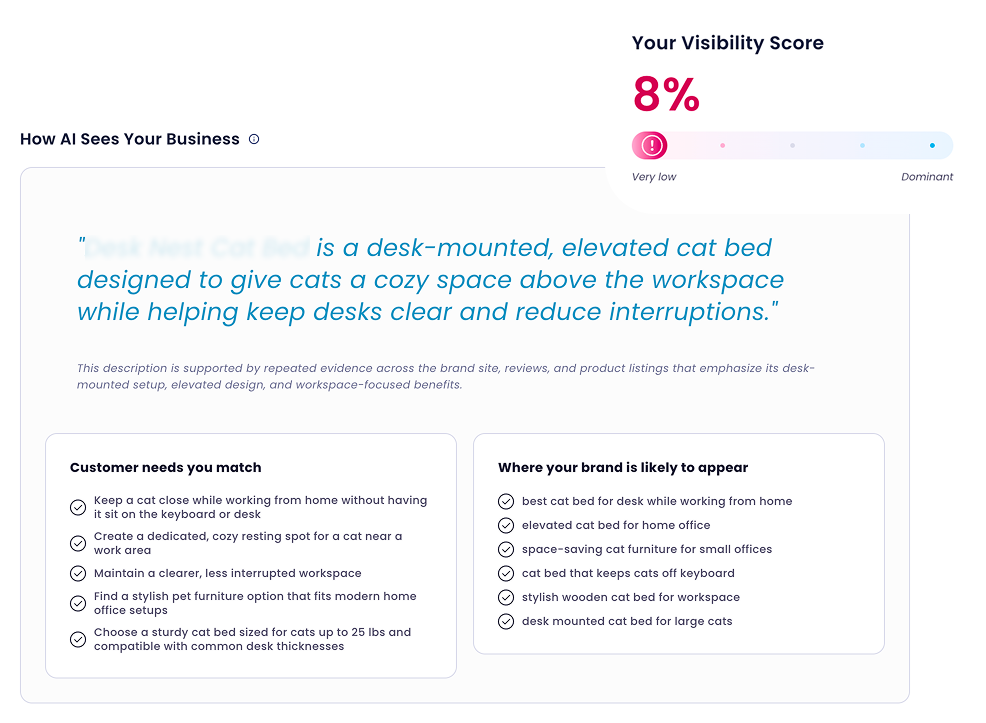
One of the most unique parts of Lebesgue AI Visibility is Brand Perception.
AI platforms don’t simply read your homepage and repeat what you say about your business. They create their own understanding of your brand based on information from your Shopify store, reviews, articles, directories, forums, and other sources across the web.
Lebesgue AI Visibility helps you understand:
- How AI describes your brand
- Which attributes are most associated with your business
- How your perception compares to competitors
- Which sources influence that perception
This helps uncover gaps between how you want your brand to be positioned and how AI platforms actually understand it.
Improve AI Recommendations Through Better Brand Positioning
AI recommendations are heavily influenced by how AI understands your business.
For example, if you sell premium coffee but AI primarily associates your brand with subscriptions, you may be recommended for very different customer prompts than intended. The same is true for apparel, beauty, home goods, and other ecommerce categories.
Understanding your AI perception helps identify gaps between your intended positioning and how AI platforms actually describe your brand. Once you know those gaps exist, you can improve the content, messaging, and sources that shape AI recommendations.
Understand the Sources Behind AI Perception
Knowing how AI sees your brand is only part of the picture.
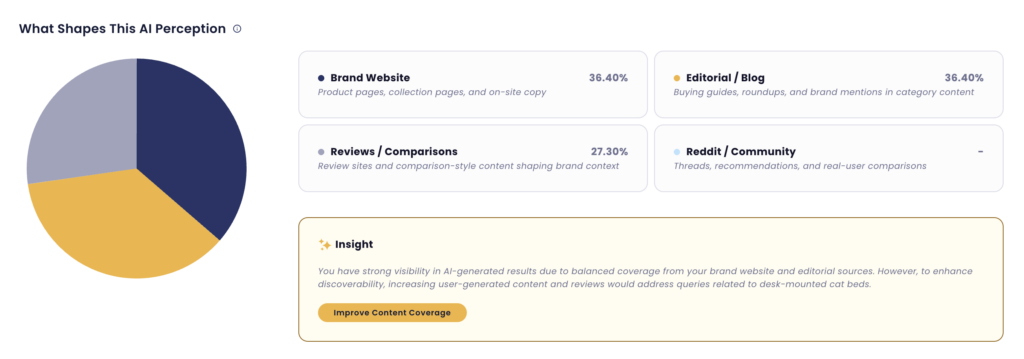
Lebesgue AI Visibility also shows which sources contribute to that perception.
If your Shopify store is the primary source, you have greater control over the information shaping AI recommendations. If third-party websites, reviews, publications, or forums are influencing perception, you’ll gain valuable insight into how customers and the market view your business.
Use Source Analysis to Improve AI Recommendations
Understanding where AI gets information about your brand can help explain why you’re being recommended for certain prompts and overlooked for others.
For example, if competitors are consistently mentioned in trusted industry publications, buying guides, or review sites that influence AI recommendations, you’ll know where additional visibility opportunities may exist.
Source analysis can also reveal whether AI is relying on outdated information, missing important brand differentiators, or pulling signals from sources that don’t accurately represent your business.
These insights help prioritize future content, SEO, PR, and brand-building efforts that can strengthen your AI visibility over time.
Track Where Your Brand Appears in AI Recommendations
Most Shopify brands have no idea which prompts trigger recommendations.
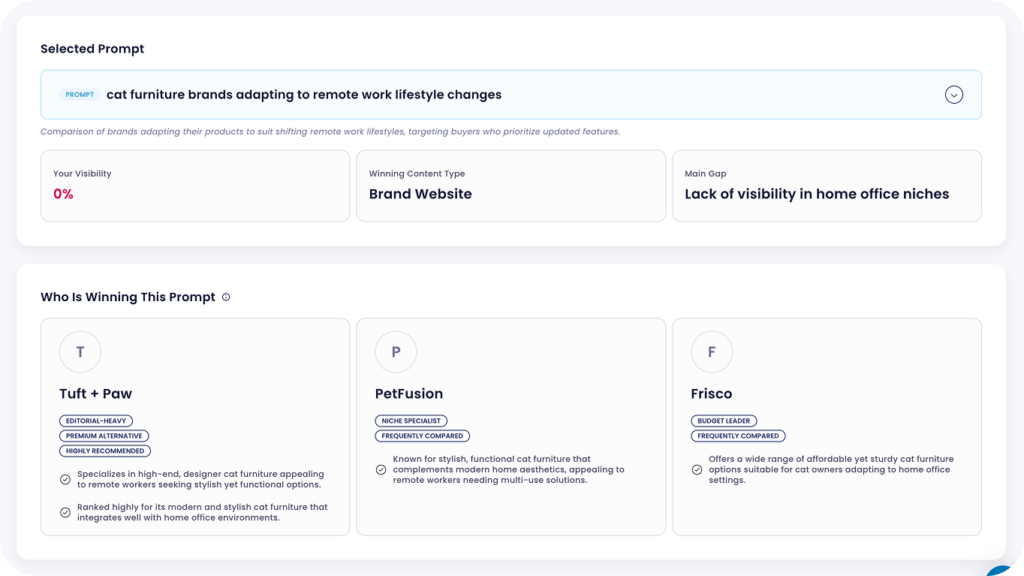
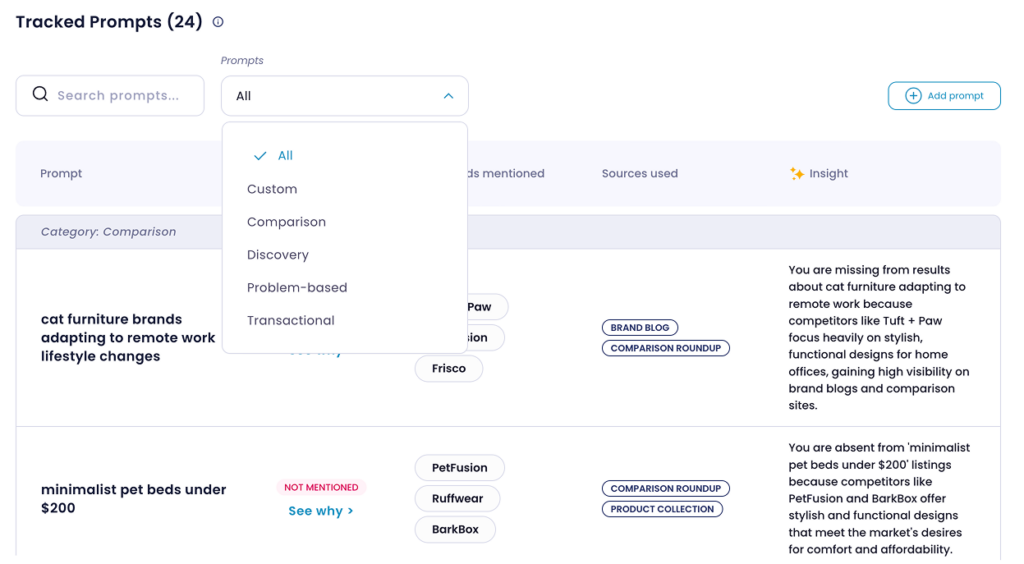
Lebesgue AI Visibility monitors customer prompts and shows where your brand appears across different categories of AI searches.
This helps answer questions such as:
- Which prompts generate recommendations for my brand?
- Which prompts are dominated by competitors?
- Where am I gaining visibility?
- Which opportunities am I missing?
Instead of manually testing prompts every week, you can continuously monitor how your visibility changes over time.
How Prompt Visibility Helps Improve AI Visibility
Not every prompt has the same value.
Some prompts help customers discover new brands, while others indicate strong purchase intent and are much more likely to influence buying decisions.
By understanding where your brand appears and where competitors are consistently recommended instead, you can identify visibility gaps and focus your optimization efforts on the prompts that matter most.
Prompt visibility also helps measure progress over time. As you improve your content, positioning, and online presence, you can see whether your brand begins appearing in more relevant AI-generated recommendations.
Analyze Competitor Visibility
AI recommendations are competitive.
When your brand isn’t recommended, another brand usually is.
Lebesgue AI Visibility helps merchants understand:
- Which competitors appear most often
- Which prompts competitors dominate
- Where competitors outperform your brand
- Which visibility gaps represent the biggest opportunities
This allows you to move beyond simple rankings and better understand the competitive landscape within AI search.
Learn Why Competitors Are Being Recommended
Competitor analysis can help explain why certain brands consistently appear in AI-generated recommendations while others do not.
By identifying which competitors dominate important prompts, you can uncover visibility gaps and better understand where your brand is falling behind.
For example, you may discover that competitors consistently appear for high-intent comparison or transactional prompts that never mention your brand. This can reveal opportunities to strengthen your positioning, improve content, or increase visibility on sources that influence AI recommendations.
Rather than guessing why competitors are being recommended, competitor analysis provides a clearer understanding of what successful brands in your category have in common and where opportunities exist to improve your own AI visibility.
Monitor Different Types of Customer Prompts
Not every prompt has the same value.
Lebesgue AI Visibility categorizes prompts into different intent groups, including:
- Discovery prompts
- Problem-based prompts
- Transactional prompts
- Comparison prompts
This makes it easier to understand where customers are finding your brand and where competitors are winning high-intent searches.
Focus on the Prompts That Drive Results
A brand appearing for a discovery prompt like “best coffee brands” may generate awareness, while a recommendation for a transactional prompt like “best coffee subscription under $20” may be much closer to a purchase.
By understanding which types of prompts generate visibility, you can prioritize the opportunities most likely to impact traffic, conversions, and revenue.
This also helps identify gaps across the customer journey. You may be highly visible during the discovery phase, but rarely appear when customers are actively comparing options or ready to make a purchase.
Understand Which Sources Influence AI Recommendations
AI recommendations don’t come from a single source.
AI platforms pull information from websites, reviews, publications, directories, community discussions, and other trusted sources.
Lebesgue AI Visibility helps identify:
- Which sources influence your brand perception
- Which sources influence competitors
- What content contributes to recommendations
- Where opportunities exist to improve visibility
Understanding these sources helps explain why certain brands consistently appear in AI-generated recommendations while others don’t.
Discover What's Influencing Your AI Visibility
Knowing where AI gets information about your brand can help explain why you’re being recommended for certain prompts and overlooked for others.
For example, if competitors are consistently mentioned in trusted industry publications, buying guides, or review sites that influence AI recommendations, you’ll know where additional visibility opportunities may exist.
Source analysis can also reveal whether AI is relying on outdated information, missing important brand differentiators, or pulling signals from sources that don’t accurately represent your business.
These insights help prioritize future content, SEO, PR, and brand-building efforts that can strengthen your AI visibility over time.
Find the Content AI Already Trusts
Improving AI visibility isn’t only about identifying gaps and opportunities.
Lebesgue AI Visibility also helps uncover the content and sources already contributing to your recommendations.
By understanding which pages, publications, reviews, or other sources are helping your brand appear in AI-generated answers, you can reinforce those signals and expand on what is already working.
Instead of guessing which content influences recommendations, you can focus your efforts on the sources and topics that are already helping increase your visibility across AI platforms.
Monitor AI Referral Traffic
Being recommended by AI is important, but visibility alone doesn’t drive growth.
The real question is whether AI-generated recommendations are sending visitors to your Shopify store.
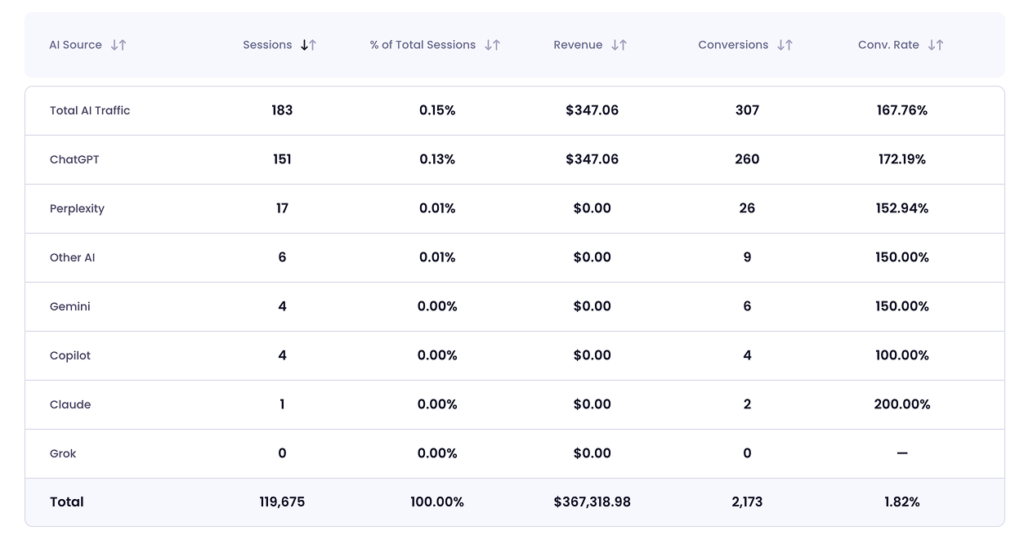
Lebesgue AI Visibility tracks referral traffic from AI platforms and helps merchants understand how visibility translates into actual visits.
You can monitor:
- AI referral traffic trends
- Traffic growth over time
- Which AI platforms send visitors
- Landing pages receiving AI traffic
Many brands are surprised to discover they are already receiving traffic from AI platforms without actively optimizing for AI visibility.
Measure the Impact of AI Visibility
AI visibility becomes much more valuable when you can connect recommendations to real customer behavior.
By monitoring AI referral traffic, you can see whether increased visibility is actually resulting in more visitors and identify which AI platforms are driving the most engagement.
This helps validate whether your optimization efforts are working and provides a clearer picture of how AI search contributes to your overall marketing performance.
As AI-generated recommendations become a larger part of the customer journey, tracking referral traffic can help you identify new growth opportunities before they become obvious in other channels.
Connect AI Visibility to Business Performance
Traffic is only one piece of the puzzle.
You also need to understand whether AI-generated visitors are becoming customers.
Combined with Le Pixel’s first-party tracking and attribution capabilities, Shopify merchants can better understand how AI-generated traffic contributes to conversions, revenue, and overall business performance.
This helps connect AI visibility efforts to real business outcomes instead of focusing solely on recommendations.
Understand the Revenue Impact of AI Visibility
Being recommended by AI is valuable, but the most important question is whether those recommendations are driving business growth.
By combining AI visibility insights with attribution and conversion data, merchants can identify which AI platforms generate the most valuable traffic and how AI-driven visitors compare to other acquisition channels.
This helps prioritize optimization efforts based on business impact rather than visibility alone.
Instead of asking, “Am I being recommended?”, you can start answering more meaningful questions:
- Which AI platforms drive the most conversions?
- How much revenue is influenced by AI-generated traffic?
- Are my AI visibility efforts improving business performance over time?
Understanding these connections helps transform AI visibility from a reporting metric into a measurable growth channel.
Why Shopify Brands Choose Lebesgue AI Visibility
There are already several AI visibility tools on the market, but most focus primarily on prompt monitoring.
Lebesgue AI Visibility combines brand perception, prompt tracking, competitor analysis, source analysis, and AI referral traffic into a single platform built specifically for Shopify stores.
Instead of managing multiple tools and manually collecting data, merchants can access the insights needed to understand and improve their AI visibility from one place.
If you’re researching the best AI visibility tools for Shopify stores, it’s important to look beyond prompt rankings and choose a solution that helps you understand how AI visibility impacts your business.
Summing Up
AI-generated recommendations are becoming an important part of how customers discover products and brands.
The brands that understand how AI sees them, where they’re being recommended, and why competitors are winning visibility will be in a much stronger position as AI search continues to evolve.
Auditing your AI visibility is the first step toward improving it. By understanding your brand perception, recommendation visibility, competitor landscape, influential sources, and AI-generated traffic, you can identify opportunities that would otherwise remain hidden.
With Lebesgue AI Visibility, Shopify merchants can audit and monitor their AI visibility in one place, making it easier to understand how AI platforms perceive their brand and what actions can help improve future recommendations.
Frequently Asked Questions about AI Visibility Tool
Lebesgue AI Visibility is a Shopify-focused AI visibility tool that helps brands understand how AI platforms like ChatGPT, Gemini, Claude, and Perplexity perceive their business, recommend products, and drive traffic to their store.
Lebesgue AI Visibility analyzes AI-generated recommendations, customer prompts, brand perception, competitor visibility, influential sources, and AI referral traffic to help merchants understand and improve their AI visibility.
With Lebesgue AI Visibility, you can monitor:
- Brand perception
- AI-generated recommendations
- Customer prompts
- Competitor visibility
- Sources influencing recommendations
- AI referral traffic
By understanding how AI platforms see your brand, which prompts trigger recommendations, where competitors outperform you, and which sources influence visibility, you can identify opportunities to strengthen the signals AI uses when generating recommendations.
Lebesgue AI Visibility helps merchants understand visibility across major AI platforms, including ChatGPT, Gemini, Claude, and Perplexity.
Yes. Lebesgue AI Visibility helps identify which competitors appear most often in AI-generated recommendations and where they outperform your brand across different prompt categories.
Yes. Lebesgue AI Visibility tracks AI referral traffic, helping merchants understand which AI platforms send visitors to their Shopify store and how that traffic changes over time.
Traditional SEO tools focus on rankings, keywords, and organic search traffic. Lebesgue AI Visibility focuses on AI-generated recommendations, brand perception, competitor visibility, influential sources, and AI-generated traffic.
Lebesgue AI Visibility is designed for Shopify brands and ecommerce businesses that want to understand how AI platforms recommend products, identify competitor opportunities, measure AI-generated traffic, and improve their visibility across AI search platforms.