Meta ads can still be worth running on Black Friday, even when CPMs rise. Among the biggest Meta spenders on Lebesgue, the median brand paid 59% more per 1,000 impressions in Black Friday week. Yet its cost per purchase fell 20% and its Meta-reported ROAS rose 19%.
That doesn’t mean every brand should scale. It means CPM is the price of reach, not the measure of profit. The decision to scale belongs to conversion rate, cost per purchase, margin and inventory.
We analyzed $22.6 million in Meta spend from September through November 2025, and compared it with the same brands a year earlier. Here’s what happened, and how to use it for this Black Friday.
What the data says
| Question | Answer from the data |
|---|---|
| When do Meta CPMs start rising before Black Friday? | In 2025, the week of November 10, when the median brand's CPM was 15% above September. In 2024, mid-October. |
| How much do Meta CPMs rise during Black Friday? | 59% above September across Black Friday week, and 84% on Black Friday itself (median brand). |
| Do higher CPMs mean a higher cost per purchase? | Not necessarily. The median brand's cost per purchase fell 20% in Black Friday week. |
| Is it worth advertising on Meta during Black Friday? | It can be. Cost per purchase fell 20% and Meta-reported ROAS rose 19%, but each brand still needs its own profit target. |
Why higher CPMs didn't hurt sales efficiency
The median brand’s sales efficiency improved in Black Friday week, even though impressions cost more.
| Median brand vs September | Black Friday week |
|---|---|
| CPM | +59% |
| Conversion rate (purchases per link click) | +48% |
| Cost per purchase | −20% |
| Meta-reported ROAS | +19% |
A 48% rise in conversion rate more than offset the pricier impressions. The data doesn’t isolate one cause: stronger offers, higher purchase intent and changes in traffic mix probably all played a part.
The takeaway is simple. A rising CPM alone can’t tell you whether Meta ads are still worth running. Cost per purchase and profit can.
When Meta CPMs rose before Black Friday
From September through the first week of November 2025, the median brand’s CPM stayed within 7% of its September level. The first clear increase came in the week of November 10, about two and a half weeks before Black Friday on November 28.
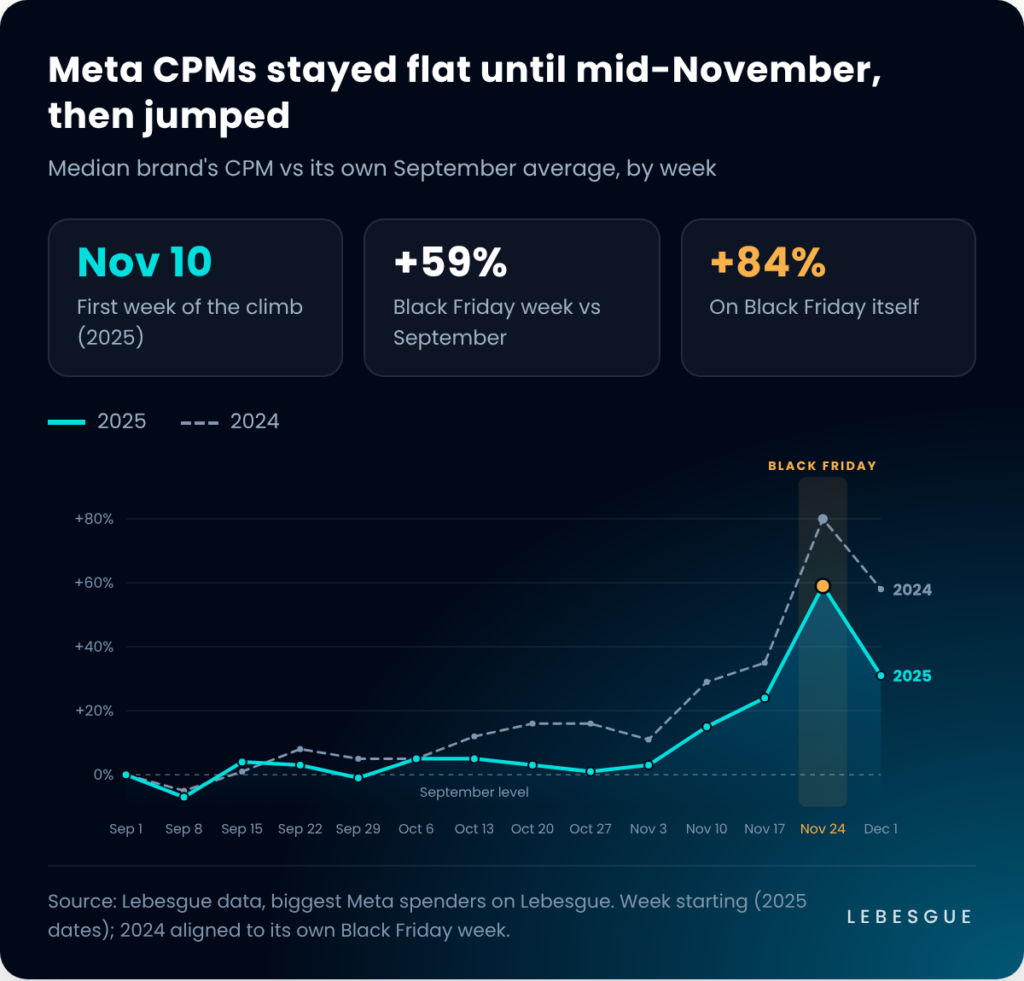
In Black Friday week, 90% of brands paid at least 10% more per 1,000 impressions than in September. The rise was broad, not driven by one or two outliers.
Black Friday was the most expensive day
| Date (2025) | Event | Median CPM vs September |
|---|---|---|
| November 10 | First clear daily rise | +13% |
| November 20 | One week before Thanksgiving | +27% |
| November 27 | Thanksgiving | +53% |
| November 28 | Black Friday | +84% |
| December 1 | Cyber Monday | +71% |
| December 2 | Tuesday after Cyber Monday | +48% |
| December 3 | Wednesday after Cyber Monday | +20% |
On Black Friday, the middle half of brands paid 59% to 116% more than in September. Costs fell fast after Cyber Monday but were still 20% above baseline on December 3.
2024 vs 2025: the rise came later and peaked lower
| Measure | 2024 | 2025 |
|---|---|---|
| First week at least 10% above September | October 14 | November 10 |
| Black Friday week, median CPM change | +80% | +59% |
| Cyber week, median CPM change | +58% | +31% |
The two seasons started four weeks apart. So there’s no dependable start date: treat both as scenarios, and be ready for costs to climb from mid-October.
Results varied by brand and category
Every category got more expensive, but by very different amounts. Category groups are small, so read these as observations about these brands, not market-wide benchmarks.
| Category | Median CPM change in Black Friday week |
|---|---|
| Home & decor | +116% |
| Electronics & sporting goods | +76% |
| Fashion & footwear | +66% |
| Beauty, health & supplements | +42% |
| Other accessories & home goods | +23% |
In Black Friday week, individual brands ranged from −51% to +172%. The brands whose CPM fell had changed what they were buying, such as shifting budget into a high-reach campaign. A lower CPM always needs to be read alongside the campaign mix.
CPMs also rose for brands that raised budgets and for brands that cut them. One fashion brand spent 60% less than in September and still saw its CPM rise 78%. Cutting spend didn’t avoid the seasonal increase.
Why Meta CPMs rise around Black Friday
Meta ads are sold through an auction. When more advertisers compete for the same audiences, impressions cost more. In November, almost every ecommerce brand raises budgets at the same time.
Competition isn’t the only factor, though. Campaign objective, bid strategy, audience, placements, geography, ad quality and estimated action rates all affect what an account pays. Meta explains how these interact in its ad delivery guidance.
That’s why a seasonal CPM rise is a signal to check, not a diagnosis. For context on what’s normal for your store, compare Meta ads benchmarks by industry and AOV, Facebook CPM by country and the latest Facebook ad CPM benchmarks.
How to decide whether Black Friday Meta ads are worth it
This year, Black Friday falls on November 27 and Cyber Monday on November 30. Use the last two seasons to plan for a range of cost scenarios, and let your own unit economics decide when to scale.
Get ready before costs move
Have offers, creative, landing pages and tracking ready by late October. In 2024 the rise started in mid-October, so waiting for a mid-November ramp can leave too little time to fix problems.
Test acquisition while reach is cheaper
In both years, the weeks before the ramp had lower CPMs. Use them to test prospecting and grow your email and SMS lists. Measure the cost and quality of the customers you acquire, not just the CPM.
Make profit the final test
With Lebesgue, you can track your shop performance hour by hour on Black Friday and compare each hour with the same hour last Black Friday. That way, you’ll know by midday whether costs and conversions are on track, not after the weekend is over.
Read the signal in context
| What you see | What to check | What to do |
|---|---|---|
| CPM rises; cost per purchase holds or falls | Conversion rate, margin, inventory | Keep scaling within profit and stock limits |
| CPM and CPC rise; CTR falls | Creative, message, audience, placements | Refresh creative and find where traffic quality dropped |
| CPM is stable; conversion rate falls | Offer, landing page, cart, checkout | Investigate the on-site experience |
| Meta ROAS rises; profit doesn't | Discounts, product costs, returns, attribution | Use contribution profit and first-party revenue as the guardrail |
Keep checking after Cyber Monday
In 2025, CPMs dropped quickly after Cyber Monday but hadn’t fully returned to normal by December 3. Judge post-BFCM campaigns on actual acquisition cost rather than assuming prices reset on a set date.
The answer depends on profit, not CPM
Rising CPMs don’t automatically make Meta ads a bad investment on Black Friday. In our data, impressions got much more expensive, yet the median brand bought sales more cheaply than in September.
Prepare before the peak, compare performance with your own baseline, and let cost per purchase, contribution profit and inventory decide whether to scale. If those hold up, a higher CPM is simply the price of reaching shoppers when they’re most ready to buy.
See where your performance is changing before BFCM. Lebesgue brings attribution, benchmarks and ecommerce marketing analytics into one view, so you can spot the Black Friday ramp in your own account as it happens. Start with Lebesgue.
Frequently Asked Questions about Meta Ads CPM
Yes, Meta ads can be worth it during Black Friday as long as the sales they drive stay profitable. Among the biggest Meta spenders on Lebesgue, the median brand paid 59% more for impressions in Black Friday week of 2025. Yet its cost per purchase fell 20% and its Meta-reported ROAS rose 19%, because shoppers converted much more often. Results still depend on your offer, margin, audience and account. Compare cost per purchase and contribution profit with your own targets before you decide to scale.
There’s no fixed date: in 2025 Meta CPMs started rising in the week of November 10, while in 2024 they started in mid-October. In 2025, the median brand’s CPM stayed within 7% of its September level until then, rose 15% two weeks before Black Friday and 24% the week before. Because the start date moves, monitor your own weekly CPM from October onward against a consistent baseline. Check whether changes in audience, placement or campaign mix explain part of any movement.
In 2025, the median brand paid 84% more per 1,000 impressions on Black Friday than its September average. Across the whole Black Friday week, the median increase was 59%, and the middle half of brands paid 59% to 116% more on the day itself. These are changes relative to each brand’s own baseline, not dollar CPM benchmarks. For typical dollar CPMs by industry, see Meta ads benchmarks by industry and AOV.
Meta CPM is the amount you pay for 1,000 ad impressions, calculated as total ad spend divided by total impressions, multiplied by 1,000. CPM tracks the price of reach and helps you spot changes in auction conditions or campaign delivery. It doesn’t tell you how many people clicked, bought or became profitable customers. That’s why it should always be read alongside CTR, CPC, conversion rate, cost per purchase and ROAS.
Meta CPMs rise around Black Friday mainly because many more advertisers compete for the same audiences during the holiday shopping season. Meta sells impressions through an auction, so more bidders push prices up. Your own campaign settings also matter: objective, bid strategy, audience, placements, geography, ad quality and creative performance all affect what you pay. Compare any increase with your historical baseline and review changes in campaign mix before blaming seasonality alone.
No, not automatically: a higher CPM is a prompt to check the rest of the funnel, not a reason to cut spend on its own. If conversion rate improves enough, cost per purchase and profit can stay healthy even when impressions cost more, as they did for the median brand in our data. If CPM rises while CTR, conversion rate and margin weaken, reducing or reallocating spend may make sense. Base the decision on acquisition cost, margin, inventory and revenue quality.
Meta CPMs start falling right after Cyber Monday, but in 2025 they hadn’t fully returned to normal by the Wednesday after. The median brand’s CPM went from 71% above September on Cyber Monday to 48% on Tuesday and 20% on Wednesday. Cyber week as a whole averaged 31% above September. Keep monitoring your account into December rather than assuming impressions get cheap the moment Cyber Monday ends.