Key takeaways about best discount percentage
- 15% vs 20%: median BFCM sales lift was 1.95x at about 15% off and 1.88x at about 20% off.
- Deep discounts: stores at about 40% off and 50% off or more grew 2.0x, no more than stores at 15%.
- The 30% exception: stores at about 30% off grew 2.4x, but they started with higher gross margins (72% vs 66%).
- No sale still grows: stores that barely discounted still sold 1.8x a normal day during BFCM week.
- Profit: among stores with cost data, gross profit grew 2.05x at 15% off but only 1.75x at 40% off.
- What is the best discount percentage – math to remember: going from 15% to 20% off, you need 12.5% more units sold just to earn the same profit at a 60% product margin.
Does a bigger discount percentage mean more revenue?
Not in our data. We grouped stores by how deep their typical BFCM discount was and compared each store’s sales during BFCM week with its own normal November day. Sales here are after discounts, so they show what the store actually took in.
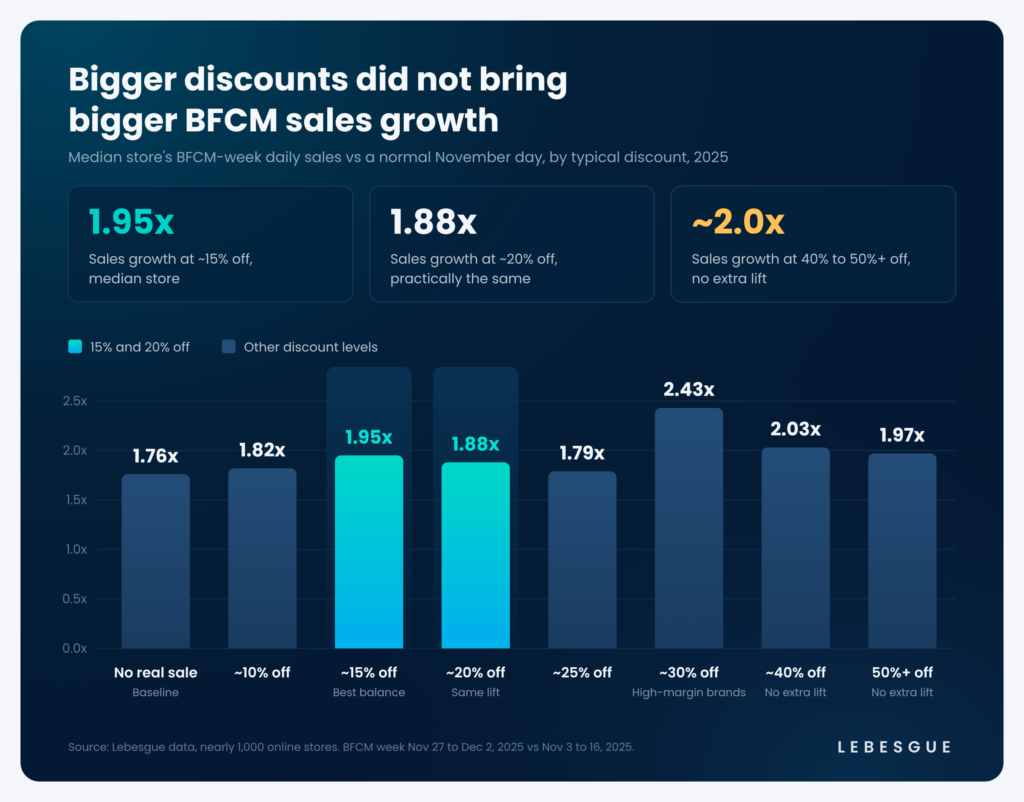
Three things stand out:
- 15% and 20% off performed the same. The median store grew 1.95x at about 15% off and 1.88x at about 20% off. The extra 5 points of discount bought no extra sales growth.
- Very deep discounts did not pay back in revenue. Stores at about 40% off and 50% off or more grew 2.0x, the same as stores at 15%, while giving away roughly three times as much per discounted order.
- The spread inside each group is bigger than the gap between groups. In every discount group, the middle half of stores ranged from roughly 1.3x to 2.9x. Your products, audience and marketing matter more than the number on the banner.
The one group that stood out was about 30% off, with a 2.43x lift. Those stores had higher gross margins than average (72% vs 66% for stores at 15% to 20% off), and many of them discount regularly. A 30% offer seems to work best as a clear, memorable deal for brands whose margins can carry it, not as a rule for everyone.
What does a deeper discount do to profit, order value and new customers?
A deeper discount mostly changes how much you keep, not how many people buy. Among more than 500 stores with product cost data in Lebesgue, gross profit growth followed sales growth closely up to about 30% off, then fell behind.
| Typical BFCM discount | Gross profit growth (median) | Normal gross margin |
|---|---|---|
| No real sale | 1.78x | 67% |
| ~15% off | 2.05x | 66% |
| ~20% off | 1.93x | 66% |
| ~30% off | 2.34x | 72% |
| ~40% off | 1.75x | 73% |
| 50%+ off | 1.93x | 79% |
Source: Lebesgue data, BFCM 2025. Stores with product cost data. Gross profit growth compares BFCM week (Nov 27 to Dec 2) with a normal November day; gross profit = sales after discounts minus product cost.
Look at the margin columns. The deeper a store’s discount, the higher its normal margin. Stores offering 40% to 50% off started with margins of 73% to 79%, and they also discounted more on normal days. Their prices are built to be discounted. If your margin is closer to 60%, a 40% offer leaves very little after product costs, shipping and ads.
Order value barely moved. The median store’s average order value during BFCM week was within 5% of its normal level in every discount group. Deeper discounts did not push shoppers to buy bigger baskets on their own.
New customers barely moved either. The share of orders from first-time customers changed by less than 2 percentage points in every group. A bigger discount did not bring in noticeably more new buyers than a moderate one.
The math behind 15% vs 20% off
Every extra point of discount has to be paid back with extra volume. Assume a product costs you 40% of its full price:
| Change in discount | Extra sales needed to keep the same revenue | Extra units needed to keep the same gross profit |
|---|---|---|
| 15% to 20% off | +6.3% | +12.5% |
| 20% to 30% off | +14.3% | +33.3% |
| 30% to 40% off | +16.7% | +50.0% |
Example assumes a product cost of 40% of the full price (60% gross margin before discounts).
In our data, stores at 20% off grew no faster than stores at 15% off. So for a typical store, the move from 15% to 20% cost profit without adding sales.
BFCM 2026 checklist
How to choose the best discount percentage
- Start at 15% if you are unsure. In our data it grew sales as much as 20% to 25% off, with more profit left per order.
- Go to 30% only if your margin can carry it. The stores that did well at 30% off had gross margins around 72%. Check what you keep per order after product cost, shipping, payment fees and ad spend before you commit.
- Don't jump to 40% or 50% to chase revenue. Those stores grew no faster than stores at 15%, and their profit grew less. Save deep discounts for clearing old stock, where the alternative is not selling at all.
- Run the breakeven math first. Moving from 15% to 20% off needs about 12.5% more units sold just to keep the same gross profit at a 60% margin. Ask whether a 5-point bigger number on your banner will really do that.
- Use structure instead of depth. Tiered offers (15% off over $75, 20% over $150), free shipping thresholds and bundles can lift order value without cutting every order by the same amount.
- Watch how often you discount. Stores with the deepest BFCM discounts also discounted more on normal days. Shoppers who learn to wait for a sale stop paying full price.
- Test it on your own store. Compare sales, gross profit and new customers from your last few promotions at different discount levels. Lebesgue shows revenue, discounts, profit and new vs returning customers by day, so you can see which offer actually paid off.
Conclusion
A bigger discount does not automatically mean more revenue. In BFCM 2025 data from nearly 1,000 stores, 15% off and 20% off grew sales by almost the same amount. Discounts of 40% and 50% or more did not bring extra growth, and they left less profit on every order. For most stores, the best discount percentage is the smallest one that still feels like a real deal to your customers, usually around 15% to 20%.
Before your next sale, check your margins, run the breakeven math and look at how your past promotions actually performed. The right discount is the one that grows profit, not just the number on the banner.
More BFCM data from Lebesgue
Before you set your BFCM discount, see what worked for other brands
The 2026 BFCM Ecommerce Benchmark Report shows how stronger brands approach discounting, paid-media timing, email pressure and creative readiness before peak.
Read the report More Black Friday articles →Frequently Asked Questions about BFCM Discounts
Not for most stores. In Lebesgue data from BFCM 2025, the median store offering about 15% off grew sales 1.95x over a normal November day, and the median store offering about 20% off grew 1.88x. The results were practically the same, but the 20% stores gave away more on every discounted order. Moving from 15% to 20% off needs about 12.5% more units sold just to keep the same gross profit at a 60% product margin, so 20% only pays off if it clearly brings in more buyers.
No. Across nearly 1,000 online stores during BFCM 2025, sales growth did not rise steadily with discount depth. Stores at about 40% off and 50% off or more grew sales about 2.0x, the same as stores at about 15% off. The spread between individual stores in each discount group was much bigger than the difference between groups. Products, audience, ads and email had more influence on results than the size of the discount.
For most stores, the best discount percentage for Black Friday is 15% to 20% off. Our data showed no extra sales growth from 20% or 25% compared with 15%. About 30% off produced the highest median growth (2.43x), but mainly at brands with gross margins around 72%. Choose the smallest discount that feels like a real deal to your customers and still leaves profit after product cost, shipping and ad spend.
Not noticeably. In every discount group we analyzed, the share of orders from first-time customers during BFCM week changed by less than 2 percentage points compared with a normal November day. A 50% discount did not attract a meaningfully larger share of new buyers than a 15% discount. New customers during BFCM depend more on ad reach and creative than on the depth of the offer.
Yes. Stores that offered almost no discounts during BFCM 2025, with fewer than 15% of orders discounted, still sold 1.76x their normal November daily revenue. Shoppers are actively buying during BFCM week, gift shopping and looking for products they planned to buy. A discount adds to this lift, but even moderate offers capture most of it.
Divide the margin you keep at the current discount by the margin you keep at the new one. With a product cost of 40% of full price, you keep 45% at 15% off and 40% at 20% off, so you need 45 / 40 = 1.125, or 12.5% more units to earn the same gross profit. Going from 20% to 30% off needs 33% more units, and from 30% to 40% off needs 50% more.