Join over 235,335 subscribers to get free advertising optimization tips and exclusive insights
Join over 235,335 subscribers to get free advertising optimization tips and exclusive insights
According to data from Lebesgue AI CMO, traffic coming from ChatGPT converts at an average rate of 3.58%.
For some Shopify stores, that’s comparable to or even higher than branded Google search campaigns. That’s surprising considering branded search traffic comes from people who already know your business.
The reason is simple. AI platforms are becoming a new discovery and recommendation channel. The question is: are they recommending your brand? In this blog post, we’ll walk through a complete AI visibility audit for Shopify stores so you can understand how AI sees your business, where you’re showing up, and whether AI-generated traffic is actually driving revenue.
Why Traditional SEO Tools Can't Measure AI Visibility
Before we begin, it’s important to understand that traditional SEO tools weren’t built to measure AI visibility.
Tools like Google Search Console, Ahrefs, and Semrush can tell you which keywords you rank for and how much organic traffic you’re receiving. What they can’t tell you is whether ChatGPT recommends your brand, how AI platforms describe your business, which competitors appear in AI-generated answers, or what sources influence those recommendations.
That’s why auditing AI visibility requires a different approach. Instead of focusing on rankings alone, you need to understand how AI platforms perceive your brand and where you’re appearing in customer conversations.
How AI Sees Your Shopify Store
Before looking at prompts, rankings, or competitors, start by understanding how AI perceives your business.
When someone asks ChatGPT, Gemini, Claude, or Perplexity about your category, the AI doesn’t simply pull information from your homepage. It creates an overall understanding of your brand based on information from your website, reviews, articles, directories, social discussions, and other sources across the web.
In other words, AI builds a perception of your business.
For example, a coffee brand may want to be known for premium single-origin coffee, but AI may primarily describe it as a subscription service. A skincare brand may focus on clean ingredients, while AI associates it with affordability. These differences matter because they influence which prompts your brand gets recommended for.
When auditing your AI visibility, ask:
- How does AI describe my brand?
- What strengths and differentiators are consistently mentioned?
- Is important information missing?
- Does AI understand my products and target audience correctly?
- How does AI’s perception compare to my competitors?
Understanding how AI sees your brand is the foundation of every visibility strategy. If AI doesn’t understand what makes your business unique, it’s much harder to earn recommendations for the searches that matter most.
Can You Influence How AI Sees Your Brand?
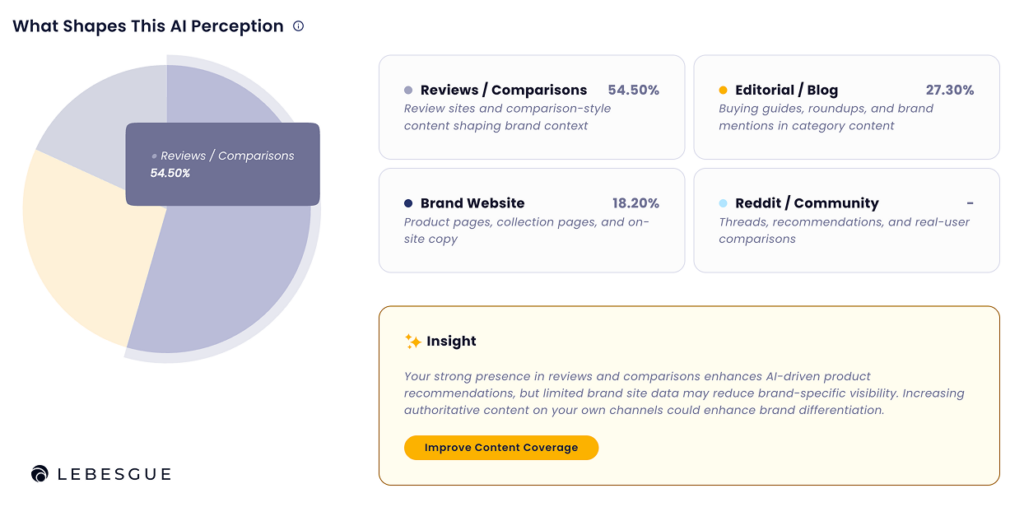
The next step is understanding where AI’s perception comes from.
If your Shopify store is the primary source influencing how AI describes your business, that’s good news. Your website is something you can control. You can update product pages, collection pages, brand messaging, FAQs, and content to better communicate what makes your business unique.
For example, if you want to be known for premium quality, sustainability, fast shipping, or a specific product category, your website gives you the opportunity to reinforce those signals.
However, AI doesn’t rely only on your website.
If most of the perception comes from third-party sources such as reviews, forums, Reddit discussions, directories, or industry publications, changing that perception becomes more difficult. These sources are outside your control, but they provide valuable insight into how customers and the broader market actually view your brand.
This is why understanding the sources behind AI perception is important. It helps you separate what you can actively optimize from what you should monitor and learn from.
Know Where You're Showing Up
Once you understand how AI sees your brand, the next step is finding out where you’re actually being recommended.
Many Shopify merchants test a few prompts in ChatGPT, see their brand mentioned once or twice, and assume their AI visibility is strong. The reality is that visibility can vary significantly depending on the question being asked.
Your brand might appear when someone searches for “best coffee subscriptions” but disappear completely for “best coffee for espresso” or “best gifts for coffee lovers.”
That’s why an AI visibility audit should look at a broad range of customer prompts instead of focusing on a handful of searches. The goal is not simply to count mentions. The goal is to understand which conversations your brand is part of and where competitors are getting recommended instead.
To do this effectively, it’s helpful to group prompts based on customer intent.
Analyze Customer Prompts and Competitors
Not all prompts have the same value.
Someone asking ChatGPT for the “best coffee brands” is at a very different stage of the buying journey than someone searching for “Trade Coffee alternatives” or “best coffee subscription under $20.”
To understand your AI visibility, you need to analyze the types of prompts your customers are likely to use and identify which competitors are being recommended for each category.
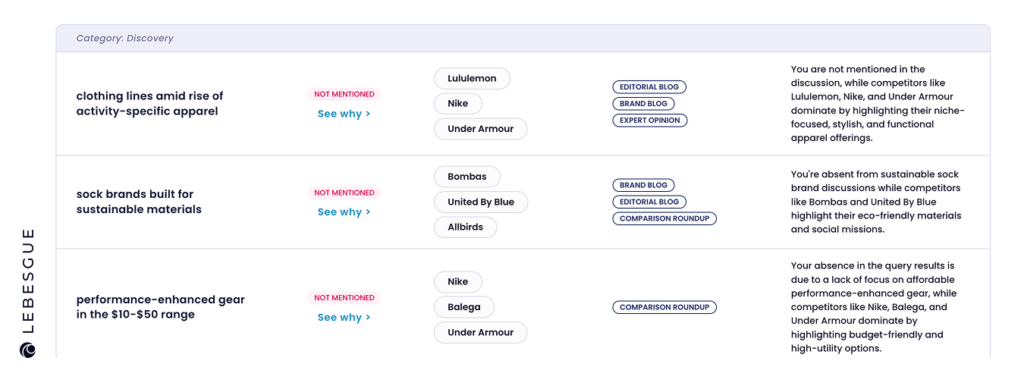
Discovery Prompts
Discovery prompts are used when customers are exploring a category and looking for options.
Examples:
- Best coffee brands
- Best sustainable fashion brands
- Best Shopify marketing apps
- Best skincare brands
These prompts are often highly competitive because AI typically recommends a small number of brands.
Problem-Based Prompts
Problem-based prompts focus on solving a specific need.
Examples:
- What coffee has the least bitterness?
- What should I wear in hot weather?
- How can I improve my sleep naturally?
These prompts often reveal opportunities to reach customers before they start actively comparing products.
Transactional Prompts
Transactional prompts come from users who are much closer to making a purchase.
Examples:
- Best coffee subscription under $20
- Best linen dress for summer
- Best protein powder for women
Recommendations appearing in these searches can have a direct impact on revenue because the user’s purchase intent is already high.
Comparison Prompts
Comparison prompts are used when customers are evaluating alternatives.
Examples:
- Trade Coffee vs Atlas Coffee Club
- Triple Whale vs Lebesgue
- Nike alternatives
These prompts can be especially valuable because the customer is actively deciding between solutions.
Finding Visibility Gaps and Competitor Opportunities
Once you’ve grouped your prompts, look beyond whether your brand appears.
Identify which prompt categories generate the most visibility, where competitors consistently outperform you, and which high-intent searches are missing your brand entirely.
You may discover that your store performs well in discovery prompts but rarely appears in comparison or transactional searches. Or you might find that a single competitor dominates multiple prompt categories.
These visibility gaps often reveal the biggest opportunities for improving AI recommendations and driving more qualified traffic to your store.
Identify Which Content Is Winning in AI Visibility
By now, you know how AI sees your brand, where you’re showing up, and which competitors are winning important prompts. The next step is understanding why.
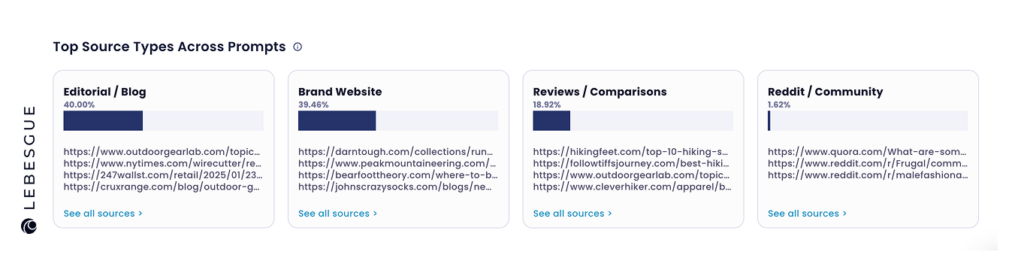
In most cases, the answer comes down to content and sources. AI platforms build recommendations based on information they find across the web, and some content consistently influences recommendations more than others.
AI platforms don’t recommend brands randomly.
When auditing your visibility, pay close attention to the sources that appear most often for both your brand and your competitors.
Ask yourself:
- Which websites are influencing recommendations?
- Are competitors being mentioned on sources where your brand is absent?
- Which topics are consistently associated with top-performing brands?
- What information is AI using when describing competitors?
You may discover that competitors are frequently mentioned in industry publications, buying guides, comparison articles, or community discussions that AI trusts when generating recommendations.
Find the Content AI Already Trusts
While competitor research can reveal new opportunities, it’s equally important to understand what’s already working for your brand.
It’s equally important to understand which content is helping your own visibility.
For example, AI may be pulling information from:
- Product pages
- Collection pages
- Blog content
- Customer reviews
- Comparison articles
- Industry publications
- Reddit discussions
- Directories and marketplaces
The goal is to identify which content and sources are contributing to recommendations so you can reinforce what’s already working and uncover gaps where competitors have an advantage.
Measure AI Traffic and Conversions
The final step of your AI visibility audit is understanding whether AI recommendations are actually driving visitors and sales.
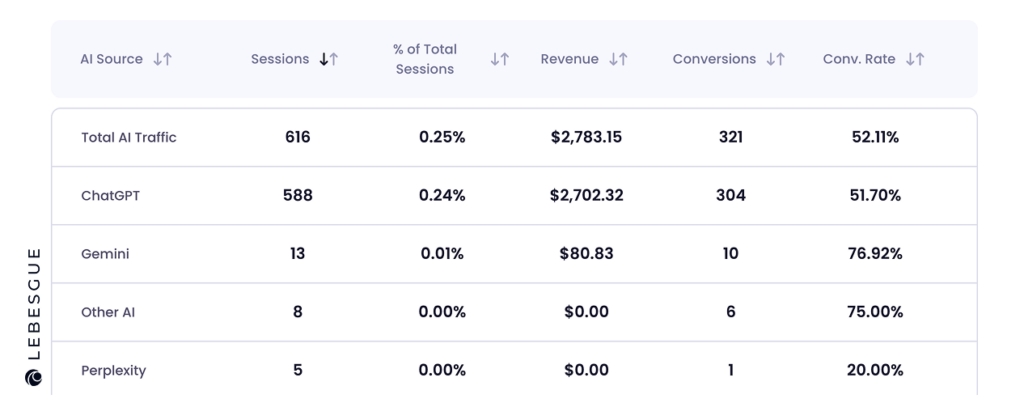
Many Shopify brands assume they don’t receive any AI traffic simply because they aren’t actively optimizing for AI visibility. In reality, you may already be getting visitors from ChatGPT, Gemini, Claude, Perplexity, and other AI platforms without realizing it.
Check Your AI Referral Traffic
A good place to start is Google Analytics 4.
Review your referral traffic sources and look for visits coming from AI platforms. You may be surprised by how much traffic is already arriving through AI-generated recommendations.
Pay attention to:
- Total AI referral traffic
- Traffic trends over time
- Landing pages receiving AI visitors
- Which AI platforms send the most traffic
Even a relatively small number of visits can indicate that your brand is already being recommended for relevant customer prompts.
If you’re using Lebesgue AI Visibility, you can also monitor traffic coming from AI platforms in one place and track how it changes over time. This makes it easier to identify growth trends and understand whether your visibility efforts are generating more visits from AI-driven discovery channels.
Visibility Is Only Half the Story
Getting traffic from AI platforms is encouraging, but traffic alone doesn’t tell you whether AI visibility is creating business value.
You also need to understand:
- Are AI visitors converting?
- How much revenue are they generating?
- Which products are they purchasing?
- How does their conversion rate compare to other channels?
This is where attribution becomes important.
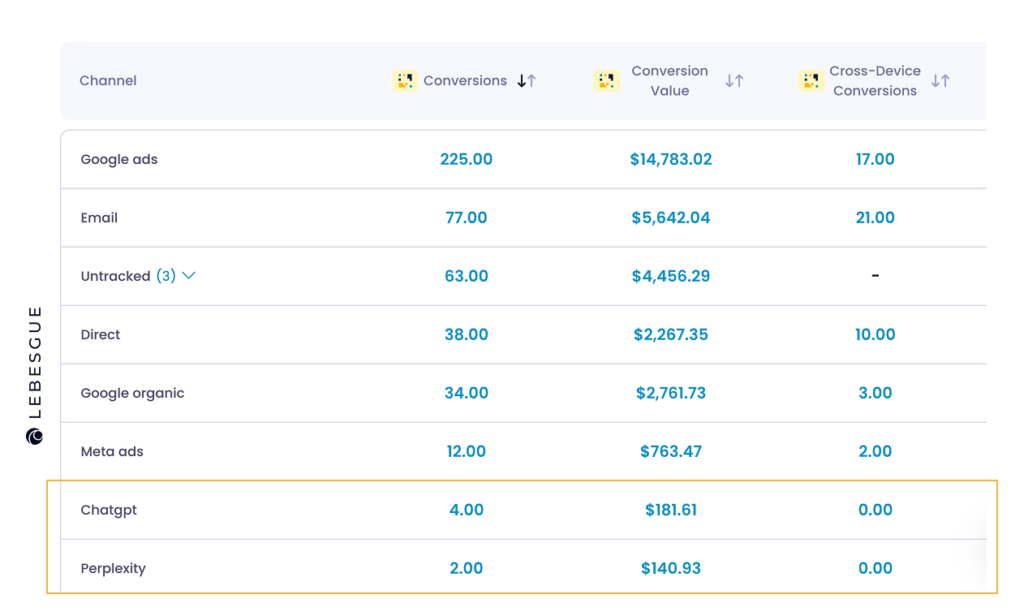
Traditional analytics platforms don’t always provide a complete picture of the customer journey. Tools like Le Pixel use first-party tracking and attribution to help Shopify brands understand where conversions are coming from and how AI-driven visitors contribute to revenue.
The goal of an AI visibility audit isn’t just to measure recommendations. It’s to understand whether those recommendations are bringing qualified visitors who become customers.
Can You Automate an AI Visibility Audit?
While it’s possible to perform an AI visibility audit manually, it can quickly become time-consuming.
Tracking how AI sees your brand, testing customer prompts, monitoring competitors, identifying influential sources, and measuring referral traffic across multiple AI platforms requires ongoing effort.
As a result, a growing number of brands are turning to dedicated AI visibility tools to automate these processes and continuously monitor their presence across AI search platforms. If you’re evaluating different solutions, check out our guide to the best AI visibility tools for ecommerce brands.
This is where Lebesgue AI Visibility can help.
Instead of manually reviewing prompts and AI-generated answers, the feature provides an automated view of your AI visibility, including brand perception, prompt visibility, competitor recommendations, source analysis, and AI referral traffic trends.
As AI search continues to evolve, having a consistent way to monitor visibility can help you spot opportunities earlier and understand how your presence changes over time.
Summing Up
Traffic from AI platforms is already converting for many Shopify stores. The question is whether your brand is being recommended when potential customers are looking for products like yours.
An AI visibility audit helps answer that question.
By understanding how AI sees your brand, where you’re showing up, which competitors are winning important prompts, what content influences recommendations, and whether AI-generated traffic is converting, you’ll have a clear starting point for improving your visibility across AI search platforms.
Because when a new discovery channel emerges, the brands that measure it first are usually the ones that benefit the most.
Frequently Asked Questions about AI Visibility for Shopify Brands
AI visibility refers to how often and how prominently your brand appears in AI-generated recommendations from platforms like ChatGPT, Gemini, Claude, Perplexity, and Microsoft Copilot.
You can test relevant customer prompts manually or use an AI visibility platform to monitor recommendations across a larger set of prompts. Looking at AI referral traffic in Google Analytics 4 can also help identify whether your brand is already being discovered through AI platforms.
If you want to automate the process, Lebesgue AI Visibility can help you track prompt visibility, competitor recommendations, brand perception, and AI referral traffic over time.
Yes. AI platforms increasingly recommend products, brands, and e-commerce stores. When users click on those recommendations, they can be directed to your Shopify store, generating referral traffic and potential sales.
AI platforms use information from multiple sources, including websites, product pages, reviews, articles, directories, and online discussions. They evaluate these signals to determine which brands are relevant for a specific query.
Most Shopify stores should review their AI visibility at least once per month. Competitive industries may benefit from more frequent monitoring as recommendations and competitors can change over time.
No. SEO focuses on ranking in traditional search engines like Google, while AI visibility focuses on appearing in AI-generated recommendations and answers. Strong SEO can support AI visibility, but high Google rankings do not guarantee AI recommendations.
Yes. While it’s possible to audit AI visibility manually, many Shopify brands use dedicated AI visibility solutions to monitor recommendations, competitor visibility, brand perception, source analysis, and AI referral traffic more efficiently.
For example, Lebesgue AI Visibility helps automate the audit process by tracking how AI sees your brand, where you’re being recommended, which competitors appear alongside you, and how AI-generated traffic changes over time.