How to Run ChatGPT Ads: A Practical Guide for Shopify Brands
ChatGPT Ads are opening a new advertising channel for Shopify brands: showing up inside conversational AI experiences when users are actively asking for help.
For Shopify founders and operators, this is especially interesting because the intent is different from traditional search. A potential customer may not search for “Shopify analytics app” directly. Instead, they might ask ChatGPT things like:
- “Why is my Shopify ROAS dropping?”
- “What is the best Shopify analytics app?”
- “How do I calculate LTV and CAC for my store?”
- “How do I measure attribution after iOS changes?”
- “How can my brand show up in ChatGPT recommendations?”
That makes ChatGPT Ads less like classic keyword advertising and more like intent-based placement inside a user’s problem-solving moment.
In this guide, we’ll cover how to set up ChatGPT Ads, how to structure campaigns and ad groups, how to write context hints, how to use UTMs, and how Shopify brands can approach early testing.
What are ChatGPT Ads?
ChatGPT Ads are ads shown inside ChatGPT. In the current Ads Manager experience, advertisers create campaigns, ad groups, and ads. Each ad includes a headline, description, landing page, image or logo, and relevance inputs such as context hints.
The most important difference from Google Ads is that ChatGPT Ads are not built around exact-match keywords. Instead, ads are matched to the broader context and intent of the conversation.
That means the system looks at signals such as:
- What the user is asking about
- The context hint provided in the ad group
- The landing page
- The ad headline
- The ad description
- The creative asset
- User engagement and relevance signals
For Shopify brands, this means your ad group should be built around the conversation you want to appear in, not just a short keyword list.
Useful link: OpenAI Help Center: Ads in ChatGPT — The Basics
How ChatGPT Ads are structured
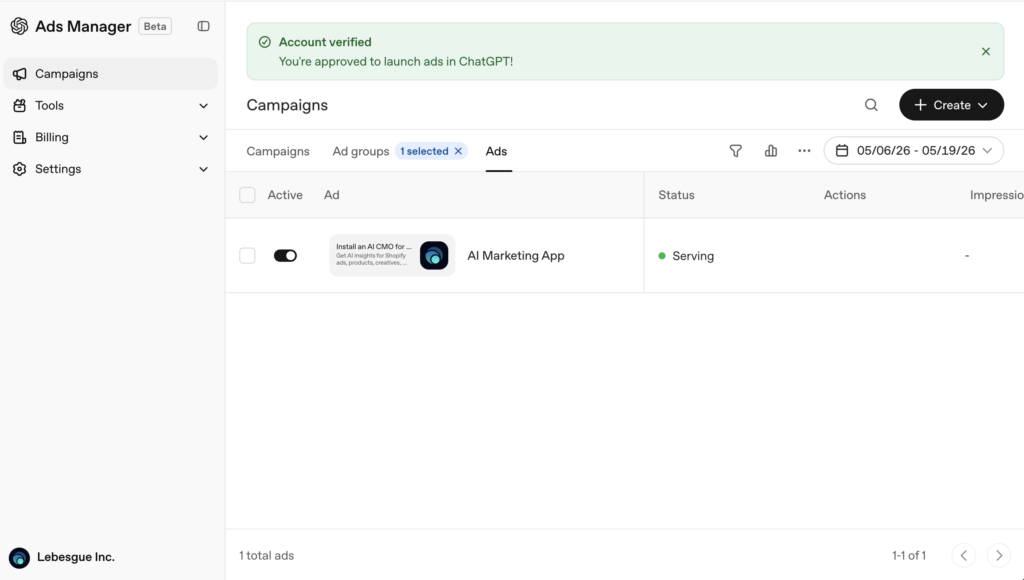
ChatGPT Ads use a familiar hierarchy:
- Campaigns
- Ad groups
- Ads
Campaigns
A campaign controls the broad objective, budget, and high-level settings. In the current setup, traffic-based campaigns such as clicks or reach are the main starting point.
For a Shopify app, the simplest first campaign could be:
- Campaign: ChatGPT Ads — Shopify App Installs
- Objective: Clicks
- Landing page: Shopify App Store page
- Market: United States first, then Canada, Australia, and New Zealand if early results look promising
Useful link: OpenAI Help Center: Create Campaigns for ChatGPT
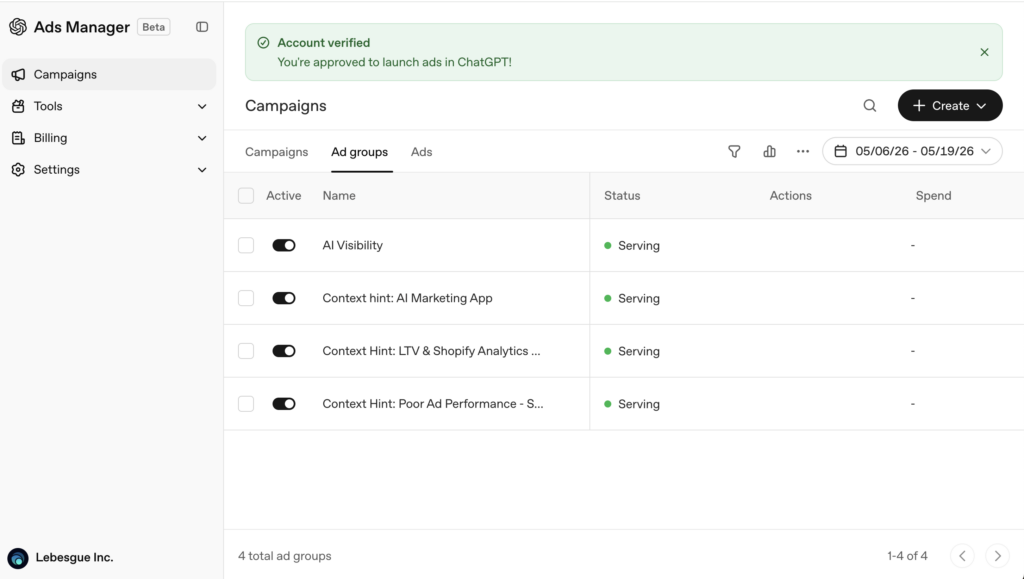
Ad groups
Ad groups should be organized around user intent. This is where many advertisers will make the biggest mistake.
Do not create one broad ad group that tries to cover everything your product does. Instead, split ad groups by the specific problem or use case the user is discussing.
For example, a Shopify analytics or marketing app might create separate ad groups for:
- Poor ad performance
- LTV and Shopify analytics
- AI marketing tools
- Affordable MMM and MTA attribution
- AI visibility in ChatGPT and AI answers
Each ad group should have its own context hint, headline, description, and UTM URL.
Useful link: OpenAI Help Center: Create Ad Groups for ChatGPT
Ads
Ads are the creative units inside each ad group. Each ad typically includes:
- Advertiser name
- Logo or favicon
- Headline
- Description
- Landing page URL
- Image asset
The headline and description matter because they are part of how the ad is understood and matched. The goal is not just to sound good. The goal is to match a real user problem.
Useful link: OpenAI Help Center: Create Ads for ChatGPT
What are context hints?
Context hints describe the conversations, topics, or keywords where your product or service may be relevant.
They are not exact-match targeting rules. Think of them as semantic guidance for the kinds of conversations where your ad should be considered.
A weak context hint is too broad:
Ecommerce businesses looking for marketing tools.
A stronger context hint is specific to the audience, problem, and platform:
Shopify founders, Shopify merchants, and Shopify operators running Shopify stores who are discussing poor ad performance, declining ROAS, rising CAC, wasted ad spend, Meta Ads performance, Google Ads performance, campaign audits, Shopify ad tracking, and how to understand why paid marketing is not driving profitable growth.
The second version is better because it defines:
- The audience: Shopify founders, merchants, and operators
- The platform: Shopify
- The problem: poor ad performance
- The language users may use: ROAS, CAC, wasted ad spend, Meta Ads, Google Ads
- The underlying intent: understanding why growth is not profitable
The best context hints are not keyword dumps. They read like a description of the user’s situation.
Use this formula:
Audience + platform + problem + related topics + decision moment
For Shopify brands, that might look like:
Shopify founders and operators running Shopify stores who are trying to understand why paid marketing is not profitable, how to improve ROAS, how to reduce CAC, how to audit Meta Ads and Google Ads, and how to decide what to fix next.
Context hint best practices
- Keep each ad group focused on one user intent.
- Include Shopify explicitly if you only want Shopify traffic.
- Include the language your customers actually use.
- Avoid broad audience terms like “marketers” or “business owners.”
- Avoid mixing too many product features in one ad group.
- Treat context hints as conversation matching, not exact keyword targeting.
Why ecommerce brands need a different ChatGPT Ads strategy
ChatGPT Ads are especially interesting for the ecommerce ecosystem because online store operators ask very specific, high-intent questions. They are not only browsing for tools. They are trying to solve operational problems across the full commerce stack.
For Shopify brands, relevant conversations may touch many parts of the ecommerce growth system:
- Paid acquisition: Meta Ads, Google Ads, TikTok Ads, ROAS, CAC, MER, budget allocation, and campaign audits.
- Store analytics: Shopify revenue, product performance, customer cohorts, LTV, retention, repeat purchase rate, and profitability.
- Creative strategy: hooks, UGC, product angles, ad fatigue, offer testing, and creative performance.
- Attribution and measurement: MTA, MMM, incrementality, post-iOS attribution problems, and channel-level growth impact.
- AI visibility: how brands appear in ChatGPT, AI search, shopping recommendations, comparison answers, and category research.
This is why broad targeting like “ecommerce marketing” is usually too vague. A better strategy is to build ad groups around specific ecommerce problems that Shopify founders and operators are already asking ChatGPT to solve.
In other words, ChatGPT Ads should not only promote a product. They should match the way ecommerce teams think: What is broken? What should I measure? What should I fix next? Which tool can help me make a better decision?
Five ChatGPT Ads angles for Shopify brands
For a Shopify marketing app, the cleanest structure is to build each ad group around one reason someone might need the product.
Below are five examples.
1. Poor ad performance
User intent
The user is asking why their Shopify ads are not working.
Example conversations:
- “Why is my Shopify ROAS dropping?”
- “What should I check when Meta Ads stop working?”
- “How do I know if I’m wasting ad spend?”
- “Why is CAC increasing?”
Context hint example
Shopify founders, Shopify merchants, Shopify operators, and growth marketers running Shopify stores who are discussing poor ad performance, declining ROAS, rising CAC, unstable MER, wasted ad spend, Meta Ads performance, Facebook Ads issues, Google Ads performance, campaign audits, Shopify ad tracking, budget allocation, and how to understand why paid marketing is not driving profitable growth for their Shopify store.
Headline example: Find What’s Hurting Your Ads
Description example: Analyze your Shopify ads, ROAS, CAC, and growth opportunities.
2. LTV and Shopify analytics apps
User intent
The user is looking for better Shopify analytics, customer insights, LTV, CAC, cohort analysis, or retention reporting.
Example conversations:
- “What is the best Shopify analytics app?”
- “How do I calculate LTV for my Shopify store?”
- “How do I track CAC and LTV by channel?”
- “Which products are driving repeat purchases?”
Context hint example
Shopify founders, Shopify merchants, Shopify operators, and ecommerce managers looking for Shopify analytics apps, LTV analysis, customer lifetime value, CAC tracking, cohort analysis, repeat purchase analysis, customer retention, product performance, Shopify revenue analytics, marketing dashboards, contribution margin, profitability, and ways to understand which customers, products, and channels drive growth for their Shopify store.
Headline example: Track LTV, CAC & ROAS
Description example: See Shopify LTV, CAC, ROAS, products, customers, and revenue clearly.
3. AI marketing app for Shopify
User intent
The user wants an AI tool that helps them make better marketing and growth decisions.
Example conversations:
- “What is the best AI marketing app for Shopify?”
- “Can AI help me improve my Shopify ads?”
- “Which AI tools help with Shopify marketing?”
- “How can I use AI to know what to improve next?”
Context hint example
Shopify founders, Shopify merchants, Shopify operators, and Shopify growth marketers looking for AI marketing tools, AI marketing apps for Shopify, AI CMO software, Shopify growth assistants, AI-powered marketing analysis, Meta Ads insights, Google Ads insights, creative recommendations, campaign recommendations, and software that helps Shopify stores decide what to improve next.
Headline example: Install an AI CMO for Shopify
Description example: Get AI insights for Shopify ads, products, creatives, and growth.
4. Affordable MMM and MTA for Shopify
User intent
The user is more advanced and wants attribution, MMM, MTA, incrementality, or better channel measurement without enterprise pricing.
Example conversations:
- “Affordable MMM tool for Shopify?”
- “How do I combine MMM and MTA?”
- “How should I measure Meta Ads after iOS changes?”
- “What is the best attribution tool for Shopify?”
Context hint example
Shopify founders, Shopify merchants, Shopify operators, and performance marketers running Shopify stores who are discussing marketing attribution, multi-touch attribution, marketing mix modeling, MMM, MTA, incrementality, media mix modeling, ROAS measurement, Shopify attribution, Meta Ads attribution, Google Ads attribution, post-iOS tracking issues, channel performance, and affordable alternatives to expensive enterprise attribution or MMM platforms.
Headline example: Affordable MMM for Shopify
Description example: Get affordable MMM and attribution insights built for Shopify brands.
5. AI visibility
User intent
The user wants to understand how their brand appears in ChatGPT or AI-generated answers, which sources influence those answers, and how to improve visibility.
Example conversations:
- “How does my brand appear in ChatGPT?”
- “How do I improve visibility in AI answers?”
- “Why does ChatGPT recommend my competitors?”
- “Which sources does ChatGPT use when recommending brands?”
- “What is GEO for ecommerce brands?”
Context hint example
Shopify founders, Shopify merchants, Shopify operators, SEO teams, and growth marketers running Shopify stores who are discussing AI visibility, ChatGPT search visibility, AI search optimization, generative engine optimization, GEO, answer engine optimization, brand visibility in ChatGPT responses, how AI tools recommend Shopify brands, which sources ChatGPT uses, how to appear in AI-generated recommendations, and how to improve a Shopify brand’s presence across AI answers.
Headline example: See Your Brand in AI Answers
Description example: See how your Shopify brand appears in ChatGPT and AI answers.
Theoretical example: how a brand like Parisa Wang could structure ChatGPT Ads
To make this more concrete, imagine a premium handbag brand like Parisa Wang running ChatGPT Ads. This is only a theoretical example, but it shows how a Shopify fashion brand could adapt the same structure to its own ecommerce ecosystem.
A brand like this should not create one generic ad group called “handbags.” Instead, it could create separate ad groups based on the different shopping conversations people have with ChatGPT.
Example Ad Group 1: Work bags for professional women
User intent: The shopper is looking for a polished everyday bag for work, commuting, meetings, or office outfits.
Example context hint:
Shoppers looking for elegant work bags, professional handbags, structured leather bags, laptop-friendly handbags, quiet luxury office bags, commuter bags for women, and polished accessories for workdays, meetings, and business travel.
Headline example: Elegant Work Bags
Description example: Discover polished leather bags made for workdays and evenings.
Example Ad Group 2: Affordable luxury handbags
User intent: The shopper wants a premium-looking handbag without traditional luxury markups.
Example context hint:
Shoppers comparing affordable luxury handbags, designer-quality leather bags, quiet luxury handbags, premium craftsmanship, direct-to-consumer handbag brands, and alternatives to expensive luxury designer bags.
Headline example: Luxury Without Markups
Description example: Shop refined leather handbags designed for everyday elegance.
Example Ad Group 3: Wedding guest and evening bags
User intent: The shopper needs a bag for an occasion, such as a wedding, dinner, event, or evening outfit.
Example context hint:
Shoppers looking for wedding guest handbags, evening bags, elegant clutches, occasion bags, formal outfit accessories, dinner bags, and versatile handbags that transition from day to night.
Headline example: Bags for Every Occasion
Description example: Find refined handbags for weddings, dinners, and evenings out.
The lesson is that even for a consumer brand, the best ChatGPT Ads structure is not based only on product categories. It is based on shopping intent, use case, comparison behavior, and decision moments. Each ad group should represent a different user intent, not just a different wording of the same ad.
Why UTMs are mandatory
Because ChatGPT Ads are still early, advertisers should not rely only on platform reporting. UTMs are essential for understanding which ad groups drive real results.
A clean UTM structure looks like this:
utm_source=chatgpt
utm_medium=paid_ai
utm_campaign=shopify_app_ads
utm_content={ad_group_angle}
For example:
https://apps.shopify.com/advertising-insights?utm_source=chatgpt&utm_medium=paid_ai&utm_campaign=shopify_app_ads&utm_content=poor_ad_performanceIf you run multiple ads inside one ad group, add utm_term for creative-level tracking:
utm_term=find_whats_hurting_your_adsRecommended UTM examples
| Ad group | UTM content |
|---|---|
| Poor Ad Performance | poor_ad_performance |
| LTV & Shopify Analytics | ltv_shopify_analytics |
| AI Marketing App | ai_marketing_app |
| Affordable MMM + MTA | affordable_mmm_mta |
| AI Visibility | ai_visibility |
Track performance beyond clicks:
- App Store visits
- Shopify installs
- Store connections
- Activation rate
- Trial starts
- Paid conversion
- CAC by ad group
- Customer quality by ad group
Creative best practices for ChatGPT Ads
In ChatGPT Ads, the creative does two jobs:
- It helps the system understand what the ad is about.
- It helps the user decide whether the ad is relevant to the conversation.
Good ad copy should be:
- Specific
- User-problem-led
- Benefit-led
- Matched to the context hint
- Written in the language of the user
- Short enough to fit platform limits
Avoid generic copy like:
Grow your business with AI.
Use specific copy like:
Find What’s Hurting Your Ads
or:
Track LTV, CAC & ROAS
For the first test, using a logo as the image is reasonable. Once data starts coming in, test product screenshots, dashboard previews, or visual assets that match the ad group angle. The ad headline and description should pre-sell the specific reason to click before the user lands on the Shopify App Store page.
SEO and GEO lessons from ChatGPT Ads
ChatGPT Ads also teach an important lesson about organic AI visibility.
Traditional SEO asks:
How do we rank for this keyword?
GEO, or generative engine optimization, asks a broader question:
How does an AI assistant understand, cite, compare, and recommend our brand when users ask for help?
This matters because users are increasingly asking assistants for recommendations, comparisons, and explanations. A Shopify founder may ask:
- “What are the best Shopify analytics apps?”
- “Which tools help with MMM for Shopify?”
- “How do I improve Meta Ads performance?”
- “What apps help me understand LTV and CAC?”
To improve AI visibility, brands need content that is clear, structured, specific, and easy for both search engines and AI systems to understand.
FAQ: ChatGPT Ads for Shopify and ecommerce brands
What are ChatGPT Ads?
ChatGPT Ads are ads shown inside ChatGPT and matched to the context and intent of a user’s conversation. Advertisers create campaigns, ad groups, and ads with headlines, descriptions, landing pages, images, and context hints.
Are ChatGPT Ads based on keywords?
Not in the same way as traditional search ads. Context hints can include topics and keywords, but they are not exact-match targeting rules. They guide the system toward relevant conversations and user intent.
What are context hints in ChatGPT Ads?
Context hints describe the conversations, topics, or user problems where an ad may be relevant. For example, a Shopify app might use context hints around poor ad performance, LTV analytics, attribution, AI marketing tools, or AI visibility.
Why are ChatGPT Ads important for ecommerce brands?
Ecommerce operators use ChatGPT to solve real business problems: improving ad performance, choosing Shopify apps, understanding LTV, comparing products, researching competitors, planning creative strategy, and learning how to appear in AI-generated recommendations. This creates a new opportunity to advertise inside high-intent decision moments.
How should Shopify brands structure ChatGPT Ads?
Shopify brands should separate ad groups by user intent. For example: poor ad performance, Shopify analytics, AI marketing app, MMM and attribution, and AI visibility. Each ad group should have its own context hint, headline, description, and UTM URL.
Should Shopify brands send ChatGPT Ads to a landing page or Shopify App Store page?
For early tests, sending users directly to the Shopify App Store page can shorten the conversion path. Over time, brands should test dedicated landing pages for each ad group angle to improve message match and conversion quality.
What is a good ChatGPT Ads context hint for ecommerce?
A good context hint defines the audience, platform, problem, related topics, and decision moment. For example: “Shopify founders and operators running Shopify stores who are trying to understand why ROAS is dropping, how to reduce CAC, how to audit Meta Ads and Google Ads, and what to fix next.”
How many ad groups should ecommerce brands start with?
Start with a small number of focused ad groups, usually three to five. Each ad group should represent a distinct intent or product angle. Avoid combining too many features or audiences into one broad ad group.
How should I track ChatGPT Ads performance?
Use UTMs for every ad group. At minimum, track source, medium, campaign, and ad group angle. Then measure not only clicks, but installs, activations, paid conversions, customer quality, and CAC by ad group.
What is AI visibility?
AI visibility is the way a brand appears in AI-generated answers, including whether it is mentioned, how it is described, which competitors appear nearby, and which sources influence those answers.
What is GEO?
GEO stands for generative engine optimization. It is the practice of improving how a brand, product, or website is understood and surfaced by AI assistants and generative search systems.
How do ChatGPT Ads relate to GEO?
ChatGPT Ads and GEO both depend on understanding conversational intent. Ads help brands appear in paid placements, while GEO helps brands improve their organic presence in AI-generated answers. Both require clear positioning, structured content, and strong source signals.
Can consumer ecommerce brands use ChatGPT Ads?
Yes. A consumer brand can structure ad groups around shopping intent, such as work bags, wedding guest outfits, gift ideas, affordable luxury, product comparisons, or category research. The key is to match the ad to the conversation the shopper is having.
Conclusion
ChatGPT Ads are not just another paid channel. They represent a shift from keyword-based advertising to conversation-based advertising.
For Shopify brands, the opportunity is to appear at the exact moment a founder or operator is asking for help with a real growth problem: poor ad performance, unclear LTV, confusing attribution, AI marketing decisions, or visibility in AI answers.
The best way to start is simple:
- Choose one Shopify-specific audience.
- Split ad groups by user intent.
- Write context hints around real conversations.
- Use clear, benefit-led headlines and descriptions.
- Add UTMs to every ad group.
- Measure downstream quality, not just clicks.
- Expand creative volume once you find early signals.
The brands that win in ChatGPT Ads will not be the ones with the broadest targeting. They will be the ones that understand what their customers are asking and show up with the most relevant answer.