Attribution used to feel simpler. A customer clicked an ad, bought a product, and the platform reported the sale. Today, the customer journey is much harder to measure.
Customers move between devices, open emails on mobile, return through search on desktop, and convert days later after multiple visits and marketing touchpoints. At the same time, privacy changes, browser restrictions, ad blockers, and platform-specific reporting have made attribution data less complete and consistent.
That creates one of the most important questions for Shopify and ecommerce brands: which marketing efforts are actually driving revenue, and which ones are simply taking credit for it?
That’s where first-party attribution comes in. It uses data collected directly by your business to connect marketing touchpoints with customer journeys and purchases, giving you a more consistent view of how different channels contribute to revenue.
First-party attribution doesn’t promise perfect measurement, because perfect attribution doesn’t exist. Instead, it gives ecommerce brands a more reliable foundation for measuring marketing performance and making better budget decisions.
What is first-party attribution?
First-party attribution is the process of measuring marketing performance using data collected directly by your business. Instead of relying only on individual ad platforms to report what happened, it connects data from your store, website visits, conversions, and customer journeys to understand how different channels, campaigns, and touchpoints contribute to revenue.
In practical terms, first-party attribution helps answer questions like:
- How did a customer first discover your brand?
- Which channels and touchpoints contributed to the purchase?
- Which campaigns bring in high-value customers?
- Which landing pages contribute to conversions?
- Which channels appear strong in their own dashboards but perform differently when viewed across the full customer journey?
For Shopify brands, this is especially useful because a purchase rarely happens after a single click or visit. A customer might discover a product through a Meta ad, return through Google Search, sign up for email, and purchase several days later after visiting the store again.
First-party attribution connects these touchpoints to give Shopify brands a clearer view of the customer journey and how each marketing channel contributes to revenue.
Why has attribution become harder in ecommerce?
Ecommerce attribution has become harder because customer journeys are more complex, while the data available to track those journeys has become more fragmented. Privacy changes, browser restrictions, cross-device shopping, and platform-specific reporting all make it harder to connect marketing touchpoints to a purchase.
As a result, Meta Ads, Google Ads, Shopify, and other marketing platforms can report different results for the same customer journey and purchase. Understanding those differences is one of the main reasons ecommerce brands need a consistent approach to attribution.
Why is first-party attribution important for ecommerce?
First-party attribution helps ecommerce brands make better marketing and budget decisions by showing how channels contribute to customer acquisition and revenue. Instead of relying on each platform’s version of performance, teams can evaluate marketing activity using a more consistent view of the customer journey.
With first-party attribution, ecommerce teams can:
- identify which channels are creating new demand
- separate prospecting from retargeting performance
- compare different attribution models
- reduce reliance on platform-reported conversions
- understand the full customer journey, not just the last click before purchase
This becomes especially important as marketing spend grows. Small attribution errors at lower budgets may have limited impact, but at scale, they can lead to significant amounts of budget being allocated to the wrong channels.
For example, a team may invest heavily in channels that capture existing demand at the bottom of the funnel while undervaluing the acquisition channels that introduced those customers in the first place.
How does attribution improve ecommerce marketing decisions?
Attribution turns marketing data into practical decisions about where to spend, what to scale, and how to evaluate performance. A clearer view of the customer journey can change decisions across several areas.
Budget allocation
If a paid social campaign introduces a large share of new customers but email receives the final click before purchase, last-click attribution can undervalue the campaign that originally created demand. First-party attribution helps teams understand which channels are acquiring customers and which are capturing existing demand, leading to better budget allocation.
Creative performance
A creative may look inefficient within a short attribution window while still generating first visits and contributing to conversions later in the customer journey. Looking beyond the final click gives teams a more complete picture of how creative contributes to customer acquisition and revenue.
Channel mix
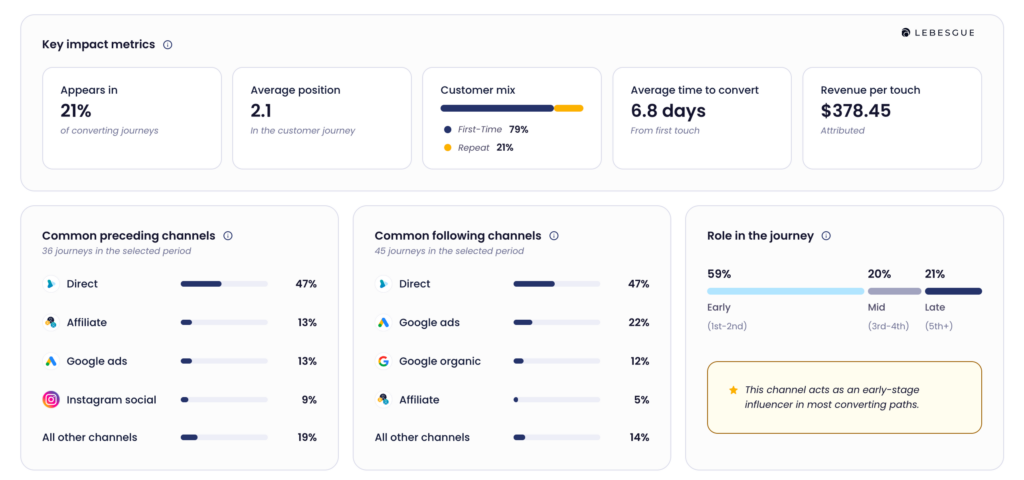
Different marketing channels play different roles in the customer journey. Some are better at generating demand, while others are more effective at converting it. First-party attribution helps teams understand those roles instead of assigning most of the value to the channel closest to the purchase.
First-touch, last-touch, and multi-touch: which model is best?
There is no single best attribution model for every ecommerce brand. The right model depends on what you want to understand: first-touch attribution focuses on customer acquisition, last-touch attribution focuses on the final interaction before purchase, while multi-touch models measure how multiple channels contribute throughout the customer journey.
Comparing several attribution models can give you a more complete picture than relying on a single model. Here’s how the most common approaches differ:
For a deeper explanation of how these models calculate and assign conversion credit, see our comprehensive guide to attribution models.
One purchase, several versions of the truth
Consider a customer who makes a $180 purchase after this journey:
- Clicks a Meta prospecting ad
- Returns through a Google branded-search ad
- Clicks a promotional email and purchases
Because each platform evaluates the journey using its own data and attribution window, their reported revenue may overlap.
The platforms may therefore report $540 in attributed revenue for one $180 order. This does not mean the store earned $540. It means three platforms are evaluating the same conversion independently.
A first-party attribution system starts with the actual $180 order and assigns that revenue according to one consistent attribution model.
What this looks like in Le Pixel customer data
The data below comes from an anonymized Shopify brand using Le Pixel and covers 5,142 Shopify orders from August 1–31, 2026, using a 90-day attribution window. It shows how the same orders can be attributed differently across marketing channels depending on the attribution model used.
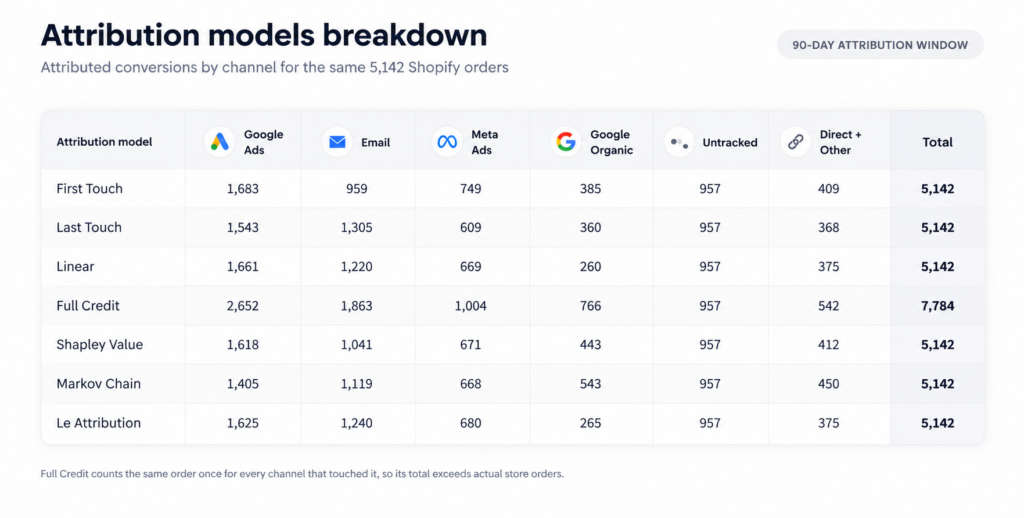
Across the same 5,142 Shopify orders, the attribution model significantly changes how much credit each channel receives.
First-touch attribution assigns 1,683 conversions to Google Ads and 749 to Meta, highlighting their role earlier in the customer journey. Under last-touch attribution, Google Ads receives 1,543 conversions and Meta 609, while email increases from 959 to 1,305 conversions.
Looking only at last-touch attribution could therefore make email appear more influential while giving less credit to acquisition channels that introduced customers earlier in their journey. For a growth team, that difference can directly influence how marketing budget is allocated across channels.
Le Attribution assigns 1,625 conversions to Google Ads, 680 to Meta, and 1,240 to email. It recognizes email’s role later in the customer journey while preserving more credit for prospecting and non-branded campaigns that contributed to creating demand.
The takeaway isn’t that Google Ads is always the strongest acquisition channel or that email is always the strongest closing channel. Channel roles vary by brand and customer journey, which is exactly why comparing attribution models is useful. In other Le Pixel customer journeys, we may see Meta playing a larger role in acquisition or channels such as ChatGPT appearing later in the journey and contributing to conversions.
What should you look for in a first-party attribution tool?
A good first-party attribution tool should do more than collect conversion data. It should help ecommerce teams connect customer journeys across channels, compare attribution models, and turn first-party data into better marketing decisions.
Reliable first-party data and tracking
Accurate attribution starts with reliable data. Look for a tool that connects store and conversion data with customer touchpoints and supports consistent campaign tracking. Poor UTM structures, inconsistent campaign naming, or missing events can make attribution less reliable.
Server-side and first-party tracking
Browser restrictions, ad blockers, and cookie limitations can create gaps in customer journeys. First-party and server-side tracking can help preserve more measurement data and reduce reliance on third-party cookies and individual advertising platforms.
Multiple attribution models
No single attribution model answers every marketing question. A strong attribution platform should let you compare first-touch, last-touch, linear, and advanced attribution models to understand how channel performance changes depending on how conversion credit is assigned.
Channel and campaign-level reporting
Channel-level reporting is useful, but growth teams often need to go deeper. Look for visibility into campaigns, campaign types, landing pages, and customer journeys so you can understand not only which channels contribute to revenue, but what within those channels is driving performance.
Measurement beyond attribution
Attribution tells you how conversion credit is distributed, but it does not necessarily tell you whether a marketing activity caused additional sales. That is where methods such as incrementality testing and Marketing Mix Modeling (MMM) become useful.
Lebesgue combines these approaches through Le Pixel and Marketing Mix Modeling. Le Pixel provides customer journey and touchpoint-level attribution across channels, while MMM analyzes broader channel impact and helps identify opportunities for budget allocation and growth.
Where Le Pixel fits into your ecommerce strategy
Lebesgue’s Le Pixel is a first-party attribution solution built for ecommerce brands that want a clearer view of how marketing channels and campaigns contribute to customer acquisition and revenue.
Le Pixel connects customer touchpoints across channels and lets teams compare multiple attribution models, including first-touch, last-touch, linear, Shapley Value, Markov Chain, and Le Attribution. Instead of relying on each platform’s attribution separately, teams can analyze performance using a consistent view of the customer journey.
At the channel and campaign level, Le Pixel helps ecommerce teams compare acquisition and retention performance, identify campaigns that create demand, and understand how customers move from their first interaction to purchase.
Le Pixel can help answer questions such as:
- Why do Meta Ads, Google Ads, and other analytics platforms report different results?
- Are retargeting campaigns receiving too much conversion credit?
- Which channels and campaigns are bringing in new customers?
- Which touchpoints contribute throughout the customer journey?
- Are we investing in channels that create new demand or primarily capture existing demand?
Combined with Marketing Mix Modeling (MMM), Lebesgue provides another layer of measurement beyond customer-level attribution, helping ecommerce teams understand broader channel performance and make more informed marketing budget decisions.
A simple decision framework checklist for ecommerce teams
Use this checklist to turn attribution data into practical marketing decisions. Instead of looking at attributed revenue alone, evaluate how different channels contribute to acquisition, conversion, and the customer journey.
Summing Up
First-party attribution gives Shopify and ecommerce brands a more consistent way to understand how marketing channels, campaigns, and customer touchpoints contribute to revenue. It won’t make attribution perfect, but it can provide a stronger foundation for marketing decisions than relying on individual platform reporting alone.
With a clearer view of the customer journey, teams can allocate budgets more effectively, evaluate acquisition and retention channels, and make better-informed decisions about where to scale marketing spend.
First-party attribution is also only one part of measuring ecommerce performance. For a broader view, explore our guides to ecommerce benchmarks and the best ad tracking and attribution software for Shopify.
Frequently Asked Questions about First-Party Attribution for Shopify and Ecommerce Brands
First-party attribution in Shopify means measuring marketing performance using data collected directly by your business, such as site visits, store conversions, and customer journeys, instead of relying only on platform-reported numbers.
It is important because privacy changes, browser restrictions, and multi-device journeys make traditional attribution less reliable. First-party attribution gives merchants a stronger view of which channels influence revenue and customer acquisition.
It is often more useful for cross-channel decision-making because it is built from data your business owns and can compare across platforms. It is still not perfect, but it usually provides a more balanced view than relying on one ad platform alone.
First-touch gives credit to the channel that first introduced the customer to your brand. Last-touch gives credit to the final interaction before purchase. First-touch is useful for acquisition analysis, while last-touch is useful for understanding what helped close the sale.
They should look for reliable first-party tracking, multiple attribution models, cross-channel reporting, first-time versus repeat customer analysis, and visibility into landing pages, journeys, and campaign-level performance. Tools such as the Le Pixel by Lebesgue are a great example of useful first-party attribution tools.
Lebesgue helps through Le Pixel, its first-party attribution product for ecommerce brands. Le Pixel tracks customer journeys across channels, supports multiple attribution models, and helps teams compare platform-reported performance with a broader first-party view.
Unlike tools whose recommended models primarily emphasize clicks, views, or fixed attribution rules, Le Pixel lets teams compare rule-based models with Shapley Value, Markov Chain attribution, and Le Attribution. This is valuable for brands that want to understand both channel combinations and the structure of customer journeys.
Le Pixel’s advantage is not simply collecting first-party data, as several ecommerce attribution platforms do that. Its differentiation lies in how Lebesgue combines advanced attribution models, campaign-level analysis, web engagement data, MMM, and ecommerce growth intelligence within one system.
The best platform depends on a brand’s needs, but Le Pixel is particularly useful for ecommerce teams that want to connect customer-level attribution with broader growth and budget-allocation analysis.