The Facebook Ads learning phase is the period after you launch or significantly edit an ad set, when Meta’s delivery system is still figuring out who to show your ads to. It usually ends once the ad set gets about 50 optimization events within 7 days.
Over the years, many advertisers have told us the learning phase hurts their cost per action (CPA) and overall ad performance. We don’t blame them for thinking so, because Meta says the same thing:
During the learning phase, the delivery system is exploring the best way to deliver your ad set, so performance is less stable and cost per action (CPA) is usually worse.
But is that actually the case? Let’s go through the data and everything you need to know.
Key takeaways
- The learning phase starts when you launch a new ad set or make a significant edit to an existing one.
- It ends after about 50 optimization events within 7 days per ad set.
- Meta says CPA is usually worse during learning. In our data, ad sets still in learning had a 10% lower CAC than ad sets that had exited.
- If an ad set can’t reach 50 events, it becomes Learning Limited. That is a forecast, not a penalty.
- To exit faster: simplify your account structure, set a realistic budget, and use broad targeting.
- Don’t switch to a more frequent event (like add-to-cart) just to escape Learning Limited. For ecommerce, it usually lowers customer quality.
What is the Facebook Ads learning phase?
The learning phase is the period that starts when you launch a new ad set or make a significant edit to an existing one.
During this time, Meta (Facebook) is learning the best way to optimize delivery based on your optimization goal, creative, audience, and other settings. As conversions accumulate, Meta gets better at knowing when and where someone is most likely to convert.
The real question is whether your CPA gets better (decreases) along with it. We answer that with data further down.
How long does the Facebook Ads learning phase last?
The learning phase typically lasts until an ad set records 50 optimization events within a 7-day period. An optimization event is whatever action you’re optimizing for, such as a purchase, lead, or other conversion. Once the ad set reaches 50, Meta has enough data to leave the learning phase and optimize more steadily.
- If you’re optimizing for purchases, you need about 50 purchases per ad set in 7 days.
- If you’re optimizing for landing page views, you need about 50 landing page views in 7 days.
After those 7 days, the ad set status changes from “Learning” to either Active or Learning Limited. We explain Learning Limited below and whether you should worry about it.
We always recommend optimizing for conversions, because you want to find people who will buy from you. We’ve also found that optimizing for conversions not only lowers CPA but significantly increases conversion rate (CR).
The key factors that affect the learning phase are:
- Optimization goal
- Audience size
- Budget
- Frequency of changes
When does the Facebook Ads learning phase restart?
According to Facebook, the learning phase restarts as soon as you make any changes to the following:
| Level | Changes that restart the learning phase |
|---|---|
| Campaign | Budget increase of more than 20%; bid amount; bid strategy |
| Ad set | Targeting; placements; optimization event; adding a new ad; bid strategy; bid amount; budget increase of more than 20%; pausing the ad set for 7 days or longer |
| Ad | Any change to the creative: visual, ad copy, headline, description, call to action, or landing page URL |
Every restart resets the 7-day clock. An account that gets edited often can spend most of its time in learning without ever exiting.
What is Learning Limited?
Here’s what Facebook has to say about the “Learning Limited” situation:
If your ad set isn’t getting enough optimization events to exit the learning phase (or if the delivery system predicts that it won’t receive enough optimization events in the future), the Delivery column reads “Learning Limited.”
Learning Limited appears in the Delivery column when an ad set isn’t getting enough optimization events to exit the learning phase, or when Meta predicts it won’t get enough in the future.
In practice, if you don’t reach about 50 conversions within 7 days, your ad set moves from “Learning” to “Learning Limited”. It isn’t a penalty, and your ads keep running. It means Meta has less data to optimize with.
Should you follow Meta's fixes for Learning Limited?
Meta recommends several steps to move an ad set from Learning Limited to Active. In our experience, following some of them makes performance worse.
The clearest example is Meta’s tip to change your optimization event to an action that occurs more often, for instance switching from “purchase” to “add-to-cart”.
You might reach 50 events much faster, but the audience quality won’t be as good:
- Optimizing for add-to-carts tells Meta to find people most likely to add an item to the cart.
- Those people are not necessarily the ones who purchase, which is what you ultimately want.
The bottom line: Learning Limited doesn’t change the way your ads are optimized. If you want an audience that converts, don’t blindly follow Meta’s recommendations, and optimize for purchases. Switching to a higher-funnel event will usually hurt performance more than staying in Learning Limited would.
Lebesgue Recommendation for Learning Phase Exit
So, what we recommend for a faster exit from the learning phase is to simplify your ad account structure, have a realistic ad budget, and increase your audience size. Let’s see how you can do that.
Simplify your ad account structure
The golden rule for both Facebook and Google advertising is to avoid an overly complicated account. Ten ad sets with lots of ads in each won’t help you or Meta. Your account fills up with data you can’t draw conclusions from, Meta doesn’t know what to optimize for, and exiting learning becomes slow.
Here’s the math. Because Meta needs about 50 conversions per ad set, ten ad sets means roughly 500 conversions (10 × 50) before you know which one performs best. And if one ad set holds ten completely different ads, Meta has to test all ten on your audience.
What works best for us: 3 to 5 ad sets, with 1 ad per ad set.
Set a realistic ad budget
To exit the learning phase you need about 50 conversions in 7 days, so your daily budget has to support that. Realistic means not too small.
Here’s a quick formula:
Daily budget ≈ target CPA × 50–60 ÷ 7
For example, say your daily budget is $15. Over 7 days that’s $105, so your CPA would need to be about $2.10 to generate 50 conversions. You might hit that when optimizing for landing page views, but since we always optimize for purchases, you’ll likely need a bigger budget.
Don’t start with just $10 or $20 a day. Work out how much you can actually spend to acquire one new customer, multiply it by 50–60 conversions, and divide by 7 to get your daily budget.
Increase your audience size
Lastly, keep an eye on your audience size. When targeting a smaller audience, your frequency will go up much faster, resulting in ad fatigue. So, as a result of that, your chances of exiting the learning phase within those 7 days will not be that high.
Most of our customers nowadays use broad targeting anyway, as it happens to give the best results. So if you’re still focusing on interest targeting or lookalikes, we’d definitely recommend expanding your audience and going as broad as possible.
How to exit the learning phase faster, according to Meta
Meta says you can exit faster with the right ad structure and with optimized budgets and bids. Here’s where we agree and where we don’t.
Learning phase structure of the ads
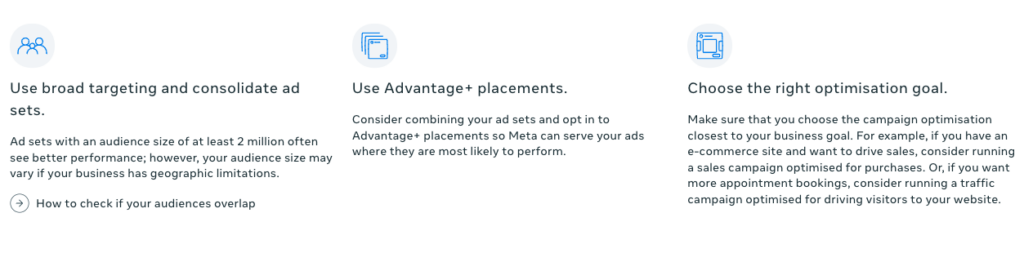
Regarding ad structure, we agree with Facebook. What they meant here is to broaden your targeting, use advantage+ placements, and choose the right optimization goal.
For Broad targeting, Facebook says that ads set with an audience size of at least 2 million often see better performance. However, the audience size may vary if your business has geographic limitations.
Next, Advantage+ placements (used to be Automatic placements). So, if you use Advantage+ placements Meta can serve your ads where they are most likely to perform.
The last optimization goal. So, here you need to know what is the campaign goal. For eCommerce businesses running Facebook ads the goal always needs to be purchases. So, for eCommerce sites and owners that want to drive sales, consider running a sales campaign optimized for purchases.
Budgets and bids for faster learning phase exit
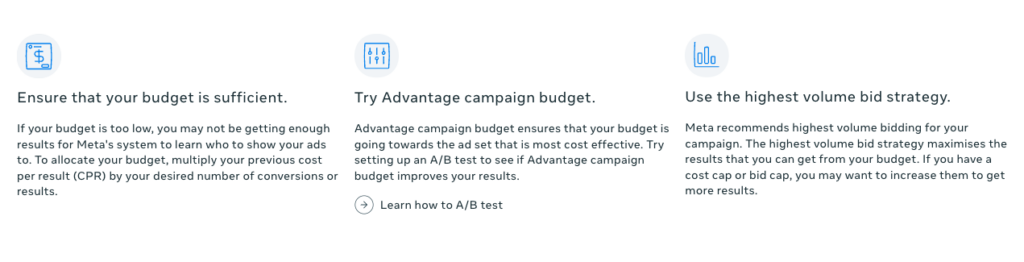
So, if you optimize your budgets and bids you can exit the learning phase faster. What Facebook is saying here is to ensure that your budget is sufficient, try advantage campaign budget, and use the higher volume bid strategy.
Ensure that your budget is sufficient and is similar to our advice. If your budget is too low, you may not be getting enough results for Meta’s system to learn who to show your ads to.
Next, they are recommending using the Advantage campaign budget. For this one, we are not agreeing with Facebook, because the results are better if you have ABO optimization, not CBO.
More Tips for Exiting Facebook Learning Phase
Now, let’s talk about some helpful tips for dealing with the learning phase of Facebook ads. If you’ve already covered the steps we discussed earlier, you can consider the following:
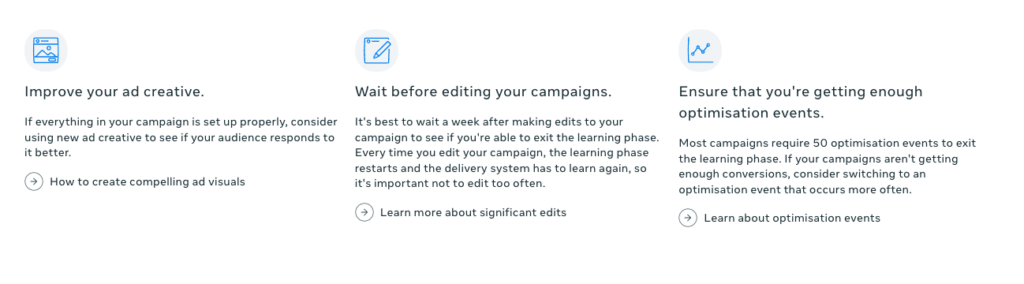
- Improve your ad creative
- Wait before editing your campaigns
- Ensure that you’re getting enough optimization events.
If everything in your campaign is set up properly, consider using new ad creative to see it your audience responds to it better.
Also, it’s a good idea to wait for about a week after making changes to your campaign to check if you can leave the learning phase. Whenever you make changes, the learning process starts over, and the system has to learn everything again. So, it’s important not to make changes too often.
Lastly, Facebook suggests considering an optimization event that happens more often. But, if you have an eCommerce business, it’s usually best to stick with your goal of getting more people to purchase.
Results During Facebook Ads Learning Phase vs. After
Now let’s look at the actual data to see if the CPA and overall results really improved once ad sets exited the learning phase.
Note: The table below includes aggregated data from multiple ad accounts and ad sets.
| Ad set status | CAC | CPC | CR | Spent | Conversions |
|---|---|---|---|---|---|
| In the learning phase | $45 | $1.90 | 5.7% | $65k | 2204 |
| Exited learning phase | $51 | $1.82 | 5% | $317k | 9702 |
*CAC= customer acquisition cost (same as CPA)
Surprisingly, as we can see from the results, ad sets that were still in the learning phase had a 10% lower CAC.
Similarly, looking at the example below (smaller sample size) we can see that the CAC was again much lower on ad sets that were still in the learning phase.
| Ad set status | CAC | CPC | CR | Conversions |
|---|---|---|---|---|
| In the learning phase | $81 | $0.85 | 1.4% | 235 |
| Exited learning phase | $100 | $1.1 | 1.5% | 591 |
This just proves that, once you exit the learning phase, the CPA doesn’t magically become better – which is the exact opposite of what Facebook tells us.
However, what you always want to measure is whether the conversion rate increase will be higher than the expected cost per click increase. More often than not, we see quite the opposite. Ads perform better during the learning phase due to a lower CPC and Facebook entering less competitive auctions.
Audience Saturation And The Learning Phase
The audience saturation graph is part of the Facebook Ad Inspect Tool that helps you understand the relationship between your ad frequency and CPA.
Looking at the graph below, you can see that as ad sets exit the learning phase, the audience saturation starts to increase. This especially happens if you’re targeting a lookalike or interest-based audience that is generally small.
What happens is that your frequency starts to increase faster than usual, resulting in ad fatigue and audience saturation. So in conclusion really, exiting the learning phase isn’t a necessity since sooner or later you’re going to need to expand your audience.
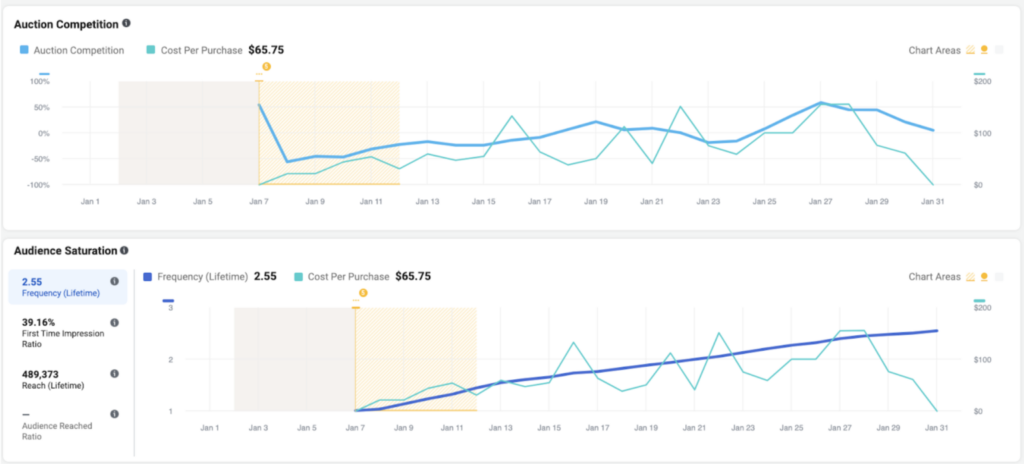
Note: the yellow area of the graph represents the learning phase.
Summing Up
Not as much as Meta suggests. The learning phase is a normal part of running Facebook Ads, and in our data, ad sets still in learning had a [10]% lower CAC than those that had exited. Leaving the phase doesn’t automatically improve performance, and it often comes with higher CPCs and faster audience saturation.
What matters is giving Meta enough data to optimize without getting in its way:
- Keep your structure simple. Use 3 to 5 ad sets with 1 ad each, so every ad set can reach about 50 events in 7 days.
- Set a budget that can deliver. Use the formula: target CPA × 50-60 ÷ 7.
- Go broad. Larger audiences delay saturation and give Meta more room to find buyers.
- Optimize for purchases. Don’t switch to add-to-cart just to escape Learning Limited.
- Avoid unnecessary edits. Every significant change restarts the 7-day clock.
Exiting the learning phase isn’t the goal. Profitable customer acquisition is, so judge your ad sets by CAC and ROAS, not by whether the Delivery column says “Learning.”
Frequently Asked Questions about Facebook Ads Learning Phase
About 50 optimization events per ad set within 7 days.
Up to 7 days if the ad set reaches the event threshold. Any significant edit restarts the clock.
Meta predicts, or has observed, that the ad set won’t get enough optimization events to exit learning. Ads still run, but Meta has less data to optimize with.
For e-commerce, we don’t recommend it. You’ll reach the threshold faster, but find people less likely to buy.
Budget increases over 20%, bid or bid strategy changes, targeting or placement changes, a new optimization event, adding a new ad, any creative edit, and pausing an ad set for 7 days or longer.
Meta recommends the Advantage campaign budget (CBO). Our data shows that ad set budget optimization (ABO) performs better.
Meta says CPA is usually worse during learning. In our data, the opposite was true: ad sets still in the learning phase had a 10% lower CAC than ad sets that had exited it.