AI is no longer just influencing how people search. It is increasingly shaping how people discover products and decide what to buy. Consumers are using AI tools such as ChatGPT, Google AI Mode and Gemini, and Microsoft Copilot to research options, compare products, and narrow down decisions before visiting a storefront. According to Bain, 30–45% of U.S. consumers already use generative AI for product research and comparison, indicating a structural shift in product discovery.
For Shopify stores, this behavior is beginning to resemble a new channel. Customers arrive after spending time inside AI interfaces, often with a clear sense of what they want and why. Unlike traditional acquisition channels, this activity happens largely outside a brand’s direct visibility, but it increasingly influences which products are considered and selected.
Adobe Analytics reports a 693% increase in generative-AI-driven traffic to retail sites during peak shopping periods, showing that AI-driven discovery is already translating into measurable commercial intent. This is not speculative behavior. It is observable in traffic patterns and conversion data today.
What This AI Channel Looks Like Today
Before any formal storefront integration, AI systems already influence discovery and decision-making. Users ask AI tools for recommendations, follow-up comparisons, and clarification around fit, price, and trade-offs. The AI synthesizes available information and suggests options. The user then clicks through to complete the purchase on a brand’s website.
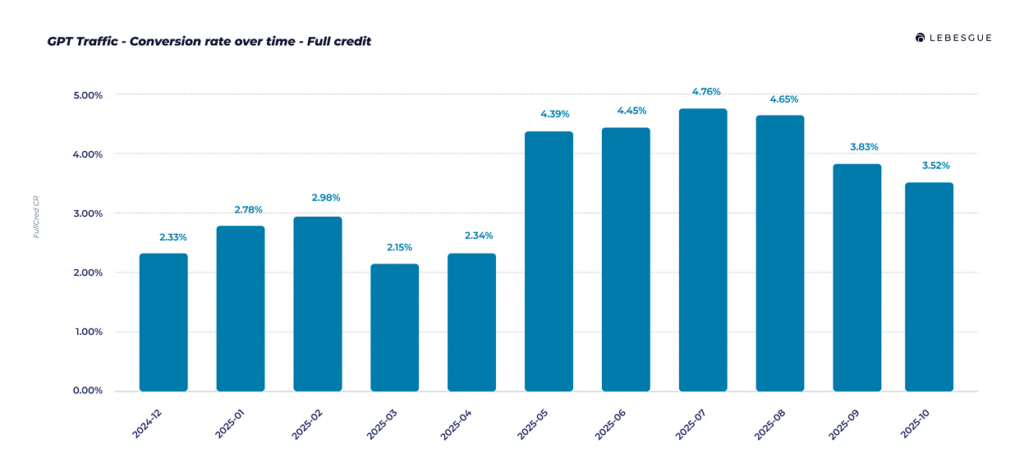
Across Shopify stores, referral traffic from AI tools such as ChatGPT, Gemini, and Perplexity has increased by roughly 30%. While this traffic still represents a smaller share of overall sessions, its performance differs meaningfully from typical website traffic.
| Traffic Source | Conversion Rate | Revenue per Session |
|---|---|---|
| Average Website Traffic | 1.23% | $8.50 |
| Performance Max (PMax) | 1.6% | $13.50 |
| Branded Search Campaigns | 3.65% | $23.20 |
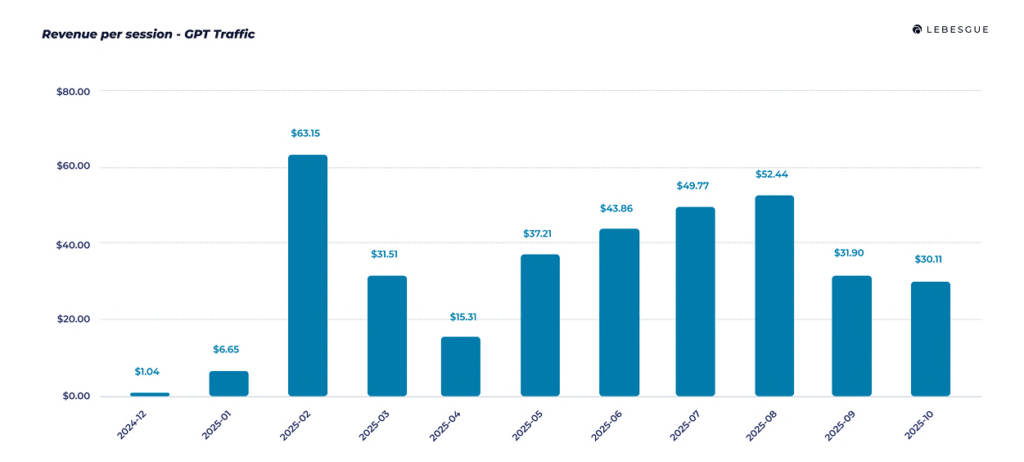
| ChatGPT Referral Traffic | 3.6% | $33.00 |
AI-referred traffic converts at roughly the same rate as branded search and generates materially higher revenue per session. Relative to the average website visit, these sessions convert nearly three times more often and generate close to four times more revenue per visit.
At first glance, this appears counterintuitive. Users arriving through branded search already know the brand. Users referred by an AI assistant may be encountering it for the first time.
The difference lies in where the decision-making work happens.
In branded search, users are often still validating. They compare prices, check alternatives, or navigate to a familiar site without having fully committed. In AI-driven discovery, much of the evaluation happens inside the AI interface. By the time a user clicks through, the decision is often largely formed.
In practice, AI-referred clicks tend to be confirmatory rather than exploratory.
Why Preparation Shapes Performance in This Channel
Because AI systems influence decisions upstream, performance in this channel is not determined by whether a new integration is enabled. It is determined by whether AI systems can confidently interpret what a product is and when it should be recommended.
AI systems do not browse storefronts the way humans do. They rely on structured inputs, including product titles and descriptions, attributes and variants, FAQs, and supporting content. When this information is incomplete, inconsistent, or overly promotional, AI systems lack the clarity required to recommend products with confidence.
Preparation in this context means treating the product catalog as AI-readable infrastructure rather than surface-level marketing copy. Clear definitions, explicit use cases, consistent terminology, and concrete details give AI systems the context they need to match products to intent.
As AI-driven discovery continues to move upstream, the quality of this underlying structure increasingly determines which products are surfaced, explained, and selected at the moment a decision is being formed.
From AI Recommendations to Agentic Storefronts
What exists today is primarily AI-driven recommendation. AI systems influence what customers consider and compare, then hand off execution to a brand’s website.
Agentic storefronts represent the next stage of this channel’s evolution.
Agentic storefronts are AI-powered shopping interfaces that allow AI systems to not only recommend products, but also act on those recommendations using live, structured product data. Instead of relying solely on publicly available information, AI systems can access real-time data from platforms such as Shopify, including availability, pricing, and variants.
This enables AI systems to move beyond advice and into execution. They can confirm inventory, select the appropriate variant, and, in some cases, complete checkout directly inside the AI interface.
In this model, AI assistants function as interactive shopping interfaces rather than referral sources. Discovery, evaluation, and selection increasingly happen inside the AI environment, with execution either remaining on the brand’s site or moving into the AI interface itself.
Agentic storefronts do not create the AI channel. They formalize and extend it by reducing friction after a recommendation has already been made.
What Determines Which Brands Are Recommended
Clear structure determines whether a product can be understood by an AI system. It defines what the product is, who it is for, and when it is relevant. This determines whether a product enters the consideration set at all.
However, eligibility is not the same as preference.
When multiple products meet the same intent, AI systems rely on confidence signals to decide which options to recommend more strongly. These signals help reduce uncertainty and validate that a product performs as described.
Common confidence signals used to recommend products include customer reviews and ratings, repeated use-case language across sources, mentions in relevant communities or creator content, and third-party validation that reinforces product claims.
These signals are not about structure. They are about credibility.
AI systems synthesize how products are talked about across the web, not just how brands describe themselves. When similar benefits, use cases, or limitations appear consistently in reviews and community discussions, AI systems gain confidence in recommending those products more decisively.
In practice, structure determines inclusion. Trust signals determine preference.
Why Small and Niche Brands Can Compete in This Channel
Traditional eCommerce visibility has largely been shaped by ad spend and brand recognition. In AI-driven discovery, that dynamic begins to shift.
AI systems do not prioritize brands based on budget or scale. They prioritize relevance to intent, clarity of use case, quality of product information, and credible trust signals.
This creates a structural advantage for smaller and more niche brands. AI interfaces allow users to describe exactly what they are looking for in natural language, often with far more precision than traditional search queries allow. Instead of navigating broad categories or generic keywords, users can explain specific needs, constraints, and preferences.
When a product clearly fits that intent, niche offerings can surface naturally, even if the brand itself is not widely known. A well-defined product with a specific use case can be easier for an AI system to match and explain than a broadly positioned alternative.
Because recommendations are formed through interpretation rather than exposure, smaller brands are not inherently disadvantaged. When a product is clearly defined, well-structured, and supported by consistent external validation, it can be recommended alongside or instead of larger competitors.
Visibility in this channel is earned through explainability and credibility rather than spend. Brands that communicate fit, value, and differentiation clearly are more likely to be surfaced, regardless of size.
Discovery vs. Checkout in an AI Channel
Opting out of direct checkout on AI interfaces does not remove products from AI-driven discovery. Products can still appear in AI-generated answers and recommendations, with users redirected to a brand’s website to complete the purchase.
What changes is not whether discovery happens, but where execution occurs.
Current behavior shows that customers often arrive after a recommendation has already been formed. This helps explain why AI-referred traffic converts well even without in-chat checkout. Discovery and evaluation happen inside the AI interface. Checkout executes a decision formed elsewhere.
Agentic storefronts reduce friction after the decision is made, but they do not replace the recommendation layer itself. For most brands, being discovered, understood, and recommended by AI systems remains the primary determinant of performance.
Summing Up
AI-driven discovery is emerging as a new commerce channel for Shopify stores. It influences decisions upstream, before customers ever reach a storefront. Agentic storefronts extend this channel by enabling AI systems to act on live product data and, in some cases, execute transactions directly.
Performance in this channel depends on how clearly products are understood and how confidently they can be recommended. Structured product data enables understanding. Trust signals shape preference.
As AI systems become a more common interface for discovery and evaluation, competitive advantage shifts away from exposure and toward clarity, credibility, and explainability.
As brands adapt to this shift, a practical challenge remains: understanding how AI systems interpret their content. Lebesgue approaches this through AI visibility agents. The AI Visibility Master agent reviews a website from the perspective of AI-powered systems, identifies where content may be unclear or misunderstood, and highlights opportunities to improve how products are explained and recommended during AI-driven discovery.