Email deliverability is the backbone of email marketing success. As Klaviyo emphasizes, even the most beautifully designed campaign cannot drive revenue if it never makes it to the inbox.
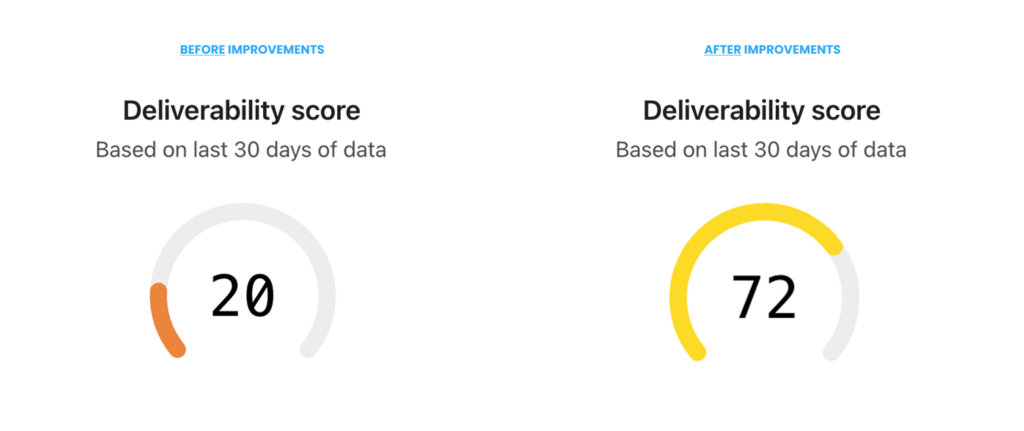
For many e-commerce brands, improving deliverability becomes a turning point in unlocking long-term email performance. In this case study, the brand began with a Deliverability Score of just 20, driven by issues across five key metrics:
- Open Rate
- Click Rate
- Bounce Rate
- Unsubscribe Rate
- Spam Complaint Rate
A closer inspection revealed the most critical problems: high bounce rates and elevated spam complaints, both strong indicators that emails were not being delivered to quality inboxes or to recipients who wanted to receive them. Klaviyo’s algorithm penalized the account accordingly, causing even legitimate emails like welcome offers to land in spam.
Below is the step-by-step process taken to successfully improve the Deliverability Score and restore healthy inbox placement.
Diagnose the Root Cause: High Bounce & Spam Complaint Rates
The first step was not to send more emails, but to understand why inbox providers were rejecting them. A high bounce rate suggested that a portion of subscribers had invalid, inactive, or low-quality email addresses. Meanwhile, a noticeable spam complaint rate signaled that recipients were either not expecting the emails or didn’t find them relevant.
Together, these issues told Klaviyo and Gmail, Outlook, Yahoo that the sender’s domain could not be trusted, lowering inbox placement for all future sends.
Pause the Welcome Flow to Prevent Further Damage
The Welcome Flow is typically a driver of first-purchase conversions. In this case, however, the welcome email containing the discount code was consistently landing in spam, indicating a weakened domain reputation.
To prevent further damage, the Welcome Flow was temporarily paused. Continuing to send automated emails under these conditions would have increased low opens and spam signals and further harming deliverability.
As a short-term workaround, the discount code was shown immediately on on-site popup at the moment of subscription.
This ensured that:
- New subscribers still received the intended welcome incentive
- Email addresses continued to be collected for future use
- No additional spam complaints or negative inbox signals were generated
Importantly, sign-ups via the popup were not unengaged users. The lack of inbox interaction was a symptom of deliverability issues, not user intent. Once domain reputation improves, these contacts can be reactivated through campaigns that reliably land in the inbox, while performance can be tracked with popup conversion metrics and code usage.
Simplify High-Intent Flows: Abandonment & Browse
While the Welcome Flow was paused, the Abandonment flow and Browse flow remained active, as the on-site popup continued to collect emails and users entering these flows had already demonstrated clear purchase intent.
To reduce inbox risk during a period of fragile deliverability, these flows were intentionally simplified:
- The flows were shortened
- An incentive (discount, free shipping, or limited offer) was delivered immediately in the first email
- Extended 3–4 email sequences were avoided
Under normal conditions, longer flows can perform well. However, when inbox reputation is weakened, multi-email sequences increase the likelihood of low opens, which can further damage the deliverability score. By showing clear value in a single, high-intent touchpoint, the brand preserved conversion potential while minimizing negative inbox signals.
Send Campaigns Only to Highly Engaged Customers
This step played a vital role in stabilizing deliverability during the recovery period.
Rather than sending campaigns to the full list, all promotional emails were intentionally limited to highly engaged subscribers: those most likely to open, click and interact positively with the brand. This reduced the risk of low engagement signals while inbox placement was still unstable. Reputation Repair was enabled, allowing Klaviyo to automatically protect campaign sends during this recovery phase.
In practice, campaigns were prepared for a larger base segment (e.g. a 365-day engaged audience), while Klaviyo automatically filtered each send so that only engagement-safe recipients actually received the emails. This allowed the brand to continue running promotions, including discounts, free shipping, and higher-value offers but without exposing the domain to unnecessary deliverability risk.
| Metric | Initial Performance | Disruption Period | Stabilized Performance | Improvement |
|---|---|---|---|---|
| Click-Through Rate | 1.80% | 0.93% | 4.13% | 129.00% |
| Open Rate | 20.32% | 6.64% | 25.87% | 27.00% |
| Place Order Rate | 1.98% | 0.46% | 2.14% | 8.00% |
This focused sending strategy created a positive feedback loop
- Emails reached subscribers who wanted them
- Higher opens and clicks strengthened engagement signals
- Stronger signals improved inbox placement
- Improved placement accelerated deliverability recovery
By protecting sender reputation during this phase, the Deliverability Score began to climb steadily toward the 40–50 range, creating the foundation for safely reintroducing additional flows.
Reactivate Flows Once Deliverability Strengthens
Only after reaching a more stable Deliverability Score of 40–50, a level where inbox placement becomes significantly more reliable were automated flows gradually restored to their original structure.
This included:
- Reintroducing multi-step Welcome Flow emails
- Re-testing subject lines and incentives
- Re-engaging more segments beyond the core engaged audience
At this point, the brand could safely scale email volume without compromising domain reputation.
Key Takeaways for Improving Deliverability in Klaviyo
1. Use Campaigns to Rebuild Reputation
During deliverability recovery, campaigns are one of the primary levers for improving domain reputation, as they allow precise audience control and can be sent only to highly engaged subscribers.
Automated flows, which are trigger-based and serve a different goal, should be sent more cautiously or simplified until inbox placement stabilizes.
2. Engagement Is the Primary Deliverability Signal
Internet Service Providers (ISPs) reward consistent, positive user engagement: opens, clicks, replies. Optimize for this first.
3. Not All Subscribers Should Receive All Emails
Segmentation is essential. When recovering deliverability, send only to the most engaged users.
4. Improve Value & Expectations
If subscribers understand what they’ll receive, how often, and why it reduces spam complaints dramatically.
5. Gradually Increase Volume
Deliverability recovery happens in stages. Once your score climbs above 40–50, flows and campaigns can be safely expanded.
Improving Klaviyo deliverability isn’t about quick fixes but rather rebuilding trust with inbox providers through consistent, high-quality email practices. By pausing problematic flows, tightening segmentation, and focusing on engaged audiences, the brand successfully improved its Deliverability Score and regained strong inbox placement.
As a result, future email campaigns and flows no longer land in spam but serve as reliable revenue drivers, just as email marketing is meant to.