By Josip Begić, Co-founder and CEO of Lebesgue
The ecommerce industry has spent years collecting more customer data in the name of better marketing. More integrations, more identifiers, more touchpoints and more detailed customer profiles, all with the promise of improving attribution and helping brands make better decisions.
I think we’ve neglected a fairly basic question. How much of that information do we actually need?
That question came back into focus on November 20, 2026, when ecommerce analytics provider Triple Whale publicly disclosed unauthorized access to some of its internal systems. Security incidents can happen to any software company. This one is a reason for the wider industry to examine why we collect customer data in the first place and how we protect what we collect. Triple Whale’s public statement
What do we need to measure acquisition cost?
Consider a question ecommerce brands ask every day. How much are we spending to acquire a new customer?
For a rough storewide estimate of ad spend per new customer, divide ad spend by the number of first-time buyers over the same period. Comparing campaigns takes another step. You need a way to connect purchases to marketing activity. Details like a customer’s name, email address, phone number or home address can stay out of many of those calculations.
The same principle applies when a brand plans next quarter’s ad budget. If you want to estimate how sales respond to changes in Meta or Google spend, or how a promotion affects demand, you can often start with aggregate figures such as weekly spend, sales and promotion dates.
Some forms of multi-touch attribution need a way to connect events across a customer journey. Under the GDPR, pseudonymous data can still count as personal data if it can reasonably be linked back to someone. The data you need depends on the question you’re trying to answer and the method you’re using. GDPR, Recital 26
Privacy should be an architectural decision
We’ve spent years building Lebesgue, a marketing analytics platform grounded in game theory, mathematics and statistics. One question we keep coming back to is how much we can measure while asking the merchant to share less customer information.
One example is our custom Google Tag Manager setup. A merchant can use it for supported reporting and attribution without a direct Shopify connection. It can tell us whether a buyer is new or returning while keeping names, email addresses and phone numbers out of the data sent to Lebesgue. How Lebesgue handles store data
That’s a design choice. Start with the business question and figure out what the system actually needs. Any SaaS company handling sensitive business or customer information should be able to explain why it needs access to that data, how long it retains it and what happens when a merchant disconnects the application.
Mathematical sophistication and security are different responsibilities
Shapley values and Markov chains can help assign credit across channels when several touchpoints are involved in a purchase. Bayesian marketing mix modeling can help estimate how changes in spending relate to sales over time.
Those models have their own engineering demands. Keeping the application secure takes access controls, code reviews, testing, monitoring, incident response and clear data-handling practices. When I evaluate a platform, I’d ask how the team builds the models and how it protects the data those models use.
Trust needs to be built before something goes wrong
When an ecommerce merchant connects an analytics platform to its store, that decision creates responsibilities well beyond the marketing department. If customer information may have been exposed, the merchant may need to find out what happened, assess its obligations and tell shoppers what they can do.
Triple Whale says it identified the unauthorized access on October 31 and contained the incident on November 1. In its November 20 statement, it said it had notified affected parties. Direct notices to affected merchants and a broader public statement serve different purposes.
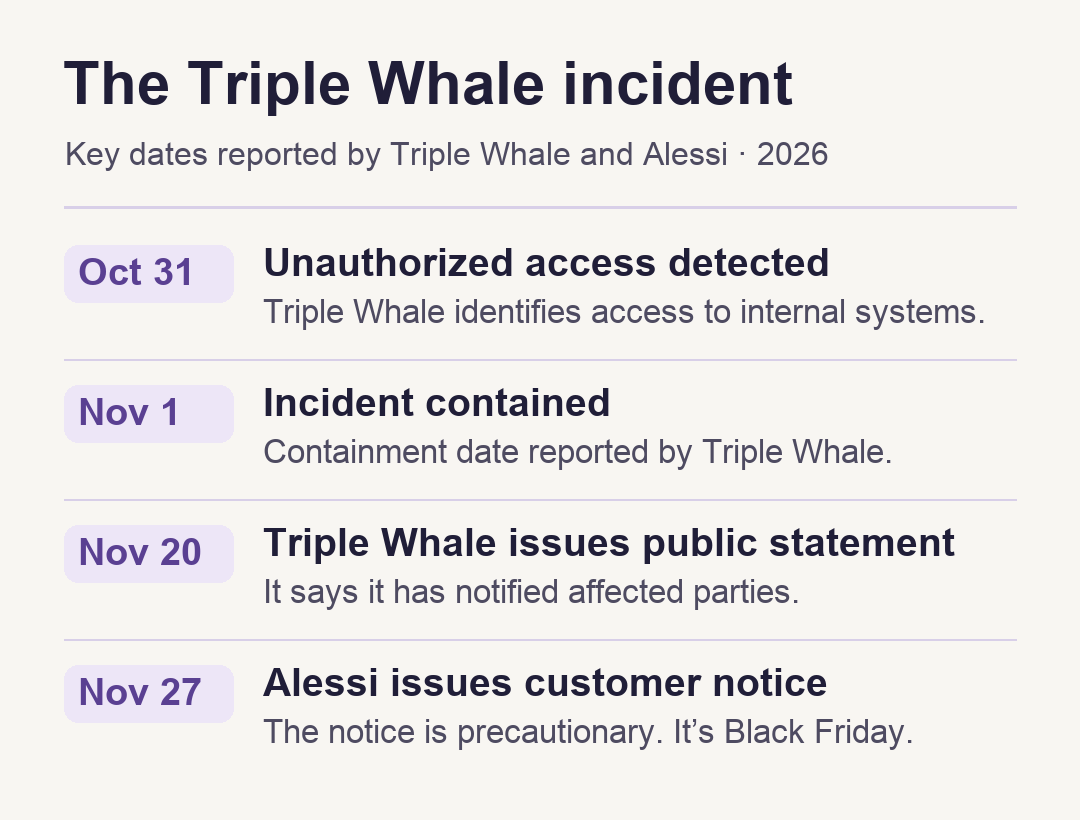
Timeline based on Triple Whale’s public statement and Alessi’s customer notice.
Think about the timing from the perspective of a Shopify founder. You’re preparing for one of the biggest shopping weekends of the year and trying to find out whether customers’ information might have been exposed, whether they might receive phishing emails and what you can tell them.
On November 27, Black Friday, Alessi said its analytics provider was still unable to tell it which individuals were affected. Alessi chose to notify all customers of its online stores as a precaution. Alessi’s November 27 notice
That’s the part I find concerning. Merchants need enough information to make decisions about protecting their customers while an investigation is still underway. Providers should say what they know, where there’s still uncertainty and when merchants can expect another update.
Before connecting an analytics app, I’d ask which customer fields it needs and what each field helps me measure. I’d also ask what happens to that data after I disconnect and what I’ll hear from the provider if something goes wrong.
As we build more powerful analytics and AI systems, I think we need to be more disciplined about the information we collect and clearer about the responsibility we’re taking on when we collect it.
Frequently asked questions
How do I estimate ad spend per new customer?
Divide your total ad spend by the number of first-time buyers in the same period. That gives you a storewide estimate. To compare individual campaigns, you also need a way to connect purchases to campaign activity.
Can marketing mix modeling work without customer profiles?
Yes. A marketing mix model can use aggregate data such as weekly ad spend and sales. It can also account for other factors that affect sales, such as promotions and seasonality. See an example of marketing mix modeling inputs
Are pseudonymous customer identifiers still personal data?
They can be. Some multi-touch attribution methods use an identifier to connect events across a customer journey. Under the GDPR, the data can still count as personal data if someone can reasonably be identified from it, including with additional information. GDPR, Recital 26
What should I ask before connecting an analytics app to my store?
I’d ask the provider which customer fields it needs and which report or decision each field supports. Then I’d ask who can access the data, how long it’s kept, what happens after I disconnect, and how I’ll hear about a security incident.