AI visibility is quickly becoming one of the most important things for brands to track.
For years, most brands focused on SEO as the main way to get discovered online. If your pages ranked well on Google, you were visible. If they did not, you had work to do.
Now, discovery is changing.
More people are using AI engines like ChatGPT, Perplexity, Gemini, Claude, and Google AI Overviews to research products, compare brands, and get recommendations. Instead of clicking through ten blue links, users can ask a question and get a short list of recommended brands.
That changes the game.
If someone asks an AI engine, “What is the best skincare brand for sensitive skin?” or “What is the best Shopify analytics tool for a growing store?”, your brand may or may not appear in the answer. Even if your website ranks well on Google, that does not automatically mean AI engines understand your brand, cite your content, or recommend your products.
This is where AI visibility tools come in.
These tools help you understand how AI engines see your brand, which prompts you appear for, who your competitors are in AI-generated answers, which sources AI engines cite, and what you can do to improve your presence.
In this post, we are going to look at the top AI visibility tools we tested, what each one does well, where it falls short, and which one might be the best fit for your team.
What is AI Visibility?
AI visibility is the way your brand appears inside AI-generated answers.
It is not just about whether your website gets mentioned once. A good AI visibility setup looks at several things:
- Whether your brand appears for important prompts
- How often your brand is recommended
- Which competitors appear next to you
- Whether AI engines describe your brand correctly
- Which sources they use when forming answers
- Whether your product pages, content, and reviews are being cited
- Whether AI-driven visitors actually convert
In traditional SEO, you might track keywords, rankings, impressions, clicks, and backlinks.
In AI visibility, you track prompts, mentions, recommendations, cited sources, sentiment, competitor presence, and AI-referred traffic.
That is why terms like AEO and GEO are becoming more common. AEO stands for Answer Engine Optimization, while GEO stands for Generative Engine Optimization. Both refer to the process of improving how your brand appears in AI-generated answers.
The goal is simple: when your potential customers ask AI engines for advice, you want your brand to be understood, trusted, cited, and recommended.
Why is it important to use an AI monitoring tool?
AI discovery is no longer something brands can ignore.
Based on Lebesgue’s proprietary Le Pixel first-party tracking data, AI-referred traffic grew by more than 900% between September 2024 and 2026. That is a major shift in a relatively short period of time, and it shows that AI engines are becoming a real traffic source for brands.
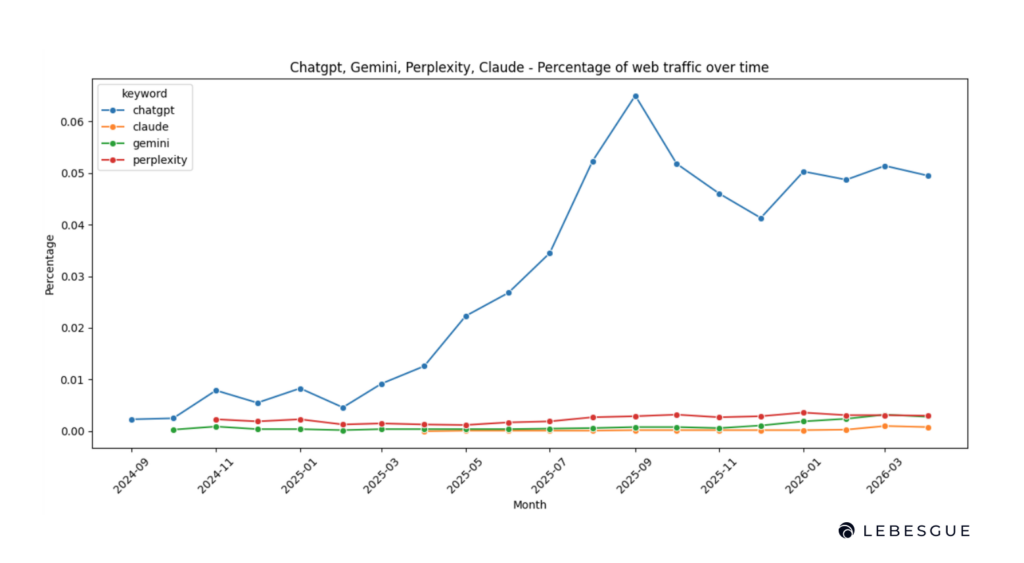
As the chart shows, ChatGPT is clearly the leader in AI-referred traffic and has seen the strongest growth over time. At the same time, other platforms like Perplexity, Gemini, and Claude are also growing, which means this is not a one-platform trend. The broader AI search ecosystem is expanding, and brands need to understand how they are showing up across all of these engines.
This matters because users are changing how they discover brands and products.
Instead of relying only on Google, more people now ask AI engines questions like:
- What is the best [product] for my needs?
- Which brands are worth considering?
- What is the best alternative to [competitor]?
- Which app or tool should I choose?
In many of these cases, the AI engine does not just return links. It gives a direct answer and recommends specific brands. If your business is not being mentioned, cited, or recommended, you may be missing visibility at a very important stage of the buyer journey.
That is why using an AI monitoring tool is becoming so important.
A good AI visibility tool helps you understand:
- which prompts matter for your brand
- whether you are appearing in AI-generated answers
- which competitors are being recommended instead of you
- which sources AI engines are citing
- how AI engines perceive and describe your brand
- what you should improve to increase your visibility
This is also why SEO alone is no longer enough. Traditional search optimization still matters, but brands now also need to think about AEO (Answer Engine Optimization) and GEO (Generative Engine Optimization). In other words, it is no longer just about ranking in search results. It is also about being understood and recommended by AI engines.
And as AI-referred traffic keeps growing, the brands that monitor and improve their AI visibility early will be in a much stronger position.
Top 5 AI Visibility tools
We tested quite a few AI visibility tools and compared them based on monitoring, prompt tracking, competitor analysis, source analysis, pricing, ease of use, and how actionable the recommendations are.
Here is our pick of the top five.
| Rank | Tool | Main focus | Price level | Quick takeaway |
|---|---|---|---|---|
| 1 | Lebesgue | AI visibility, prompt tracking, first-party AI traffic, and conversion tracking for ecommerce brands | $$ | Best option if you want to monitor AI visibility and understand which AI visits turn into sales. |
| 2 | Semrush | AI visibility inside a broader SEO and digital marketing platform | $$ to $$$ | Great for existing Semrush users who want rich AI search data, but it can feel broad. |
| 3 | Promptwatch | Prompt monitoring, citations, competitors, and content agents | $$ to $$$ | Strong prompt monitoring tool with nice source visuals, but less focused on practical next steps. |
| 4 | Otterly AI | Affordable AI search monitoring and brand tracking | $ to $$$ | Good starting point for smaller teams, although the insights can feel a bit light. |
| 5 | Peec AI | Clean AI search analytics, source tracking, and brand visibility monitoring | $$ to $$$ | Nice interface and useful source analysis, but pricing can increase quickly. |
1. Lebesgue: AI CMO
Lebesgue is our top pick because it connects AI visibility with something most tools still miss: real business impact.
Most AI visibility tools help you see whether your brand appears in AI answers. That is useful, but it is only one part of the story. Lebesgue also helps you understand which AI engines are sending traffic, how those users behave, and whether they convert.
This makes it especially useful for ecommerce brands that want more than a visibility score.
Lebesgue’s AI Visibility feature shows how AI engines recommend your brand, where you appear in real prompts, which sources influence answers, and what you can improve to get mentioned more often. The tool tracks prompts, competitors, sources, gaps, and opportunities, while also helping you understand how AI engines perceive your brand.
Key features
Prompt tracking
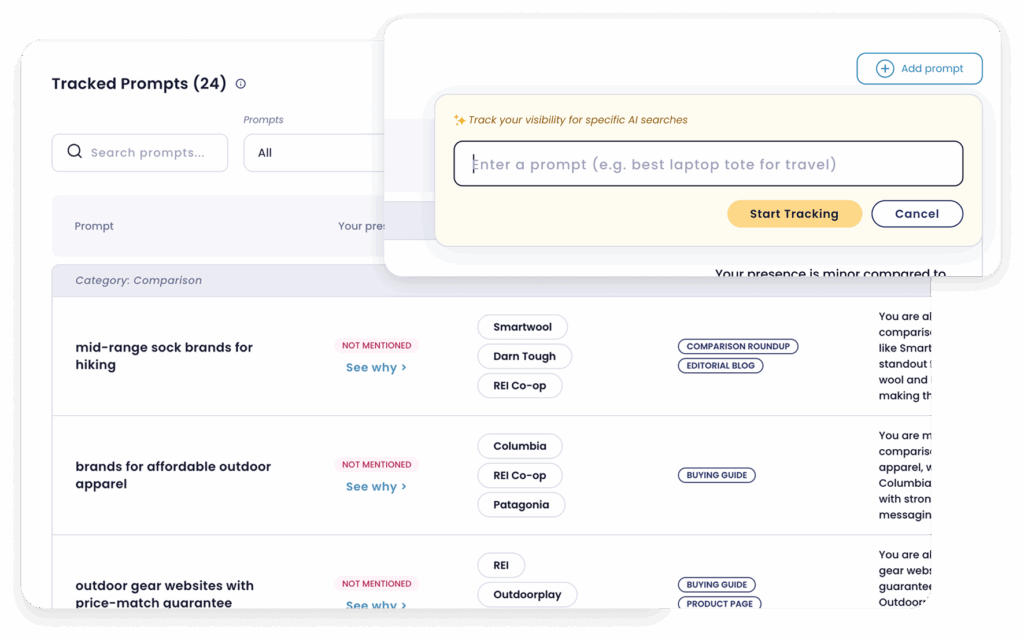
Lebesgue lets you track prompts that matter to your brand. These can include discovery prompts, comparison prompts, problem-based prompts, transactional prompts, and custom prompts.
For example, a store might track prompts like:
- “Best skincare brand for acne-prone skin”
- “Best protein powder for women”
- “Alternatives to [competitor brand]”
- “Luxury leather bags under $1K”
For each prompt, Lebesgue helps you see whether your brand appears, which competitors are recommended, what sources are cited, and why certain brands may be selected over others.
Competitor and gap analysis
One of the most useful parts of AI visibility tracking is understanding who AI engines consider your competitors.
This is not always the same as the list you have in your internal strategy document. AI engines may compare you with brands you do not normally track, or they may keep recommending a competitor because that competitor has better content, stronger third-party mentions, clearer product pages, or more helpful comparison content.
Lebesgue helps you see those gaps and understand where your brand is missing from important conversations.
Actionable recommendations
This is where Lebesgue stands out.
Some AI visibility tools give you a lot of charts, but they do not always tell you what to do next. Lebesgue focuses on turning AI visibility data into clear next steps.
It helps identify the highest-impact areas where improving your presence can increase how often your brand gets recommended. These recommendations are based on visibility gaps, competitor presence, and source coverage.
So instead of only seeing that your brand is not showing up for a prompt, you can understand why that may be happening and what to improve.
Source and citation analysis
AI engines rely on many sources when creating answers. Your own website matters, but so do product pages, blog posts, reviews, comparison articles, Reddit threads, YouTube videos, and other third-party mentions.
Lebesgue helps you analyze which sources AI engines cite and which sources shape how your brand is understood. This is important because you may discover that AI engines are pulling from outdated pages, missing important product information, or favoring competitor content because it is clearer and easier to use.
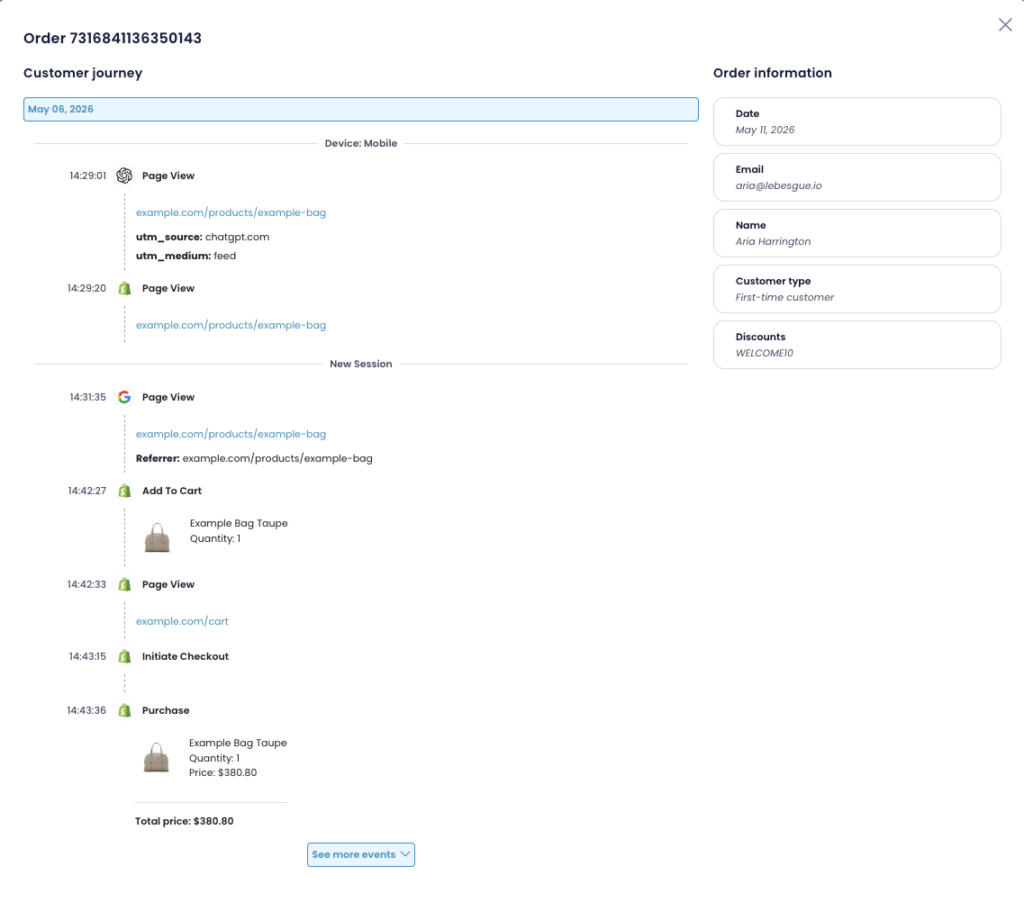
First-party AI traffic and conversion tracking with Le Pixel
Lebesgue also connects AI visibility with first-party tracking through Le Pixel.
This is a big advantage because AI visibility is not just about appearing in answers. It is also about understanding whether AI discovery leads to actual revenue.
Le Pixel helps brands track conversions across channels, including ChatGPT and organic traffic, and gives a clearer view of customer journeys, touchpoints, and attribution.
With this setup, you can see:
- Which AI engines are sending visitors
- Which customer paths include AI referrals
- Which conversions came from AI-driven traffic
- How AI traffic compares with other acquisition channels
- Whether AI visibility improvements are connected to revenue
For ecommerce brands, this matters a lot. A prompt mention is nice. A prompt mention that sends qualified traffic and leads to sales is much more useful.
AI Visibility Master agent
Lebesgue also includes AI agents, including AI Visibility Master.
This agent audits your website and checks whether it is set up in a way that AI engines can understand. It looks at discoverability, crawlability, and how well your site can be interpreted by AI-powered and LLM-based search tools. Then it gives recommendations for making your website easier for AI engines to read and use.
That is important because AI visibility is not only about content. Technical setup matters too. If AI bots cannot crawl your site properly, or if your structure is confusing, your brand may be less likely to appear in AI answers.
Pricing
Lebesgue’s Ultimate AI plan is priced at $149/month and includes AI visibility tracking along with other Lebesgue features, including Henri AI, Deep Mode AI, AI execution, budget recommendations, and advanced strategic recommendations.
You also get a 14-day free trial.
Conclusion
Lebesgue is the best choice for ecommerce brands that want to connect AI visibility with action and revenue.
It helps you track prompts, understand competitors, analyze cited sources, improve your website for AI discovery, and measure the real traffic and conversions coming from AI engines.
If you want a tool that does more than monitor your mentions, Lebesgue is the strongest option.
2. Semrush
Semrush is one of the most established names in SEO, and its AI Visibility Toolkit brings AI monitoring into a broader search and marketing workflow.
This makes Semrush a strong option for teams that already use it for SEO, keyword research, content, competitor tracking, and site audits.
The biggest advantage is the amount of data. Semrush already has a large SEO database, so its AI visibility product can connect AI mentions, prompts, topics, competitors, and cited pages with traditional search data.
The downside is that it can feel broad. If you want a focused AI visibility workflow for one brand, especially with clear prompt-by-prompt action steps, Semrush can sometimes feel like a lot to process.
Key features
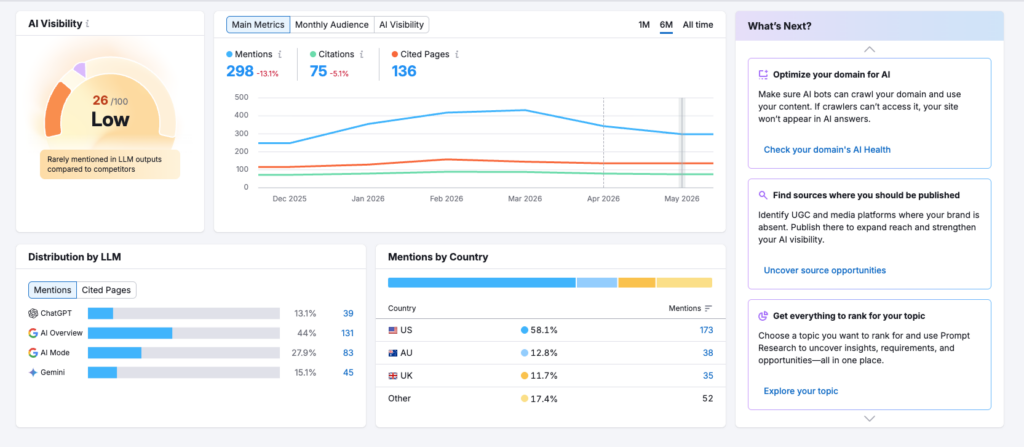
AI visibility overview
Semrush’s AI Visibility Toolkit helps brands understand how they appear in AI-generated answers, benchmark visibility and mentions, analyze sentiment, discover prompts and topics, track AI visibility daily, audit technical blockers, and identify competitive gaps.
The main reports include:
- Visibility Overview
- Competitor Research
- Prompt Research
- Brand Performance
- Prompt Tracking
- AI Search Site Audit
This gives teams a broad view of where the brand stands across AI answers.
Strong SEO context
One of the biggest reasons to use Semrush is that AI visibility does not sit alone. It is part of a broader SEO platform.
If your team already uses Semrush, adding AI visibility can make sense because you can connect AI discovery with keyword research, technical SEO, competitor analysis, and content work.
Semrush One combines its SEO Toolkit with AI Visibility features, including visibility across Google AI Overviews, ChatGPT, Gemini, and Perplexity.
Prompt and topic coverage
Semrush can feel very complete because it tracks a large number of prompts and topics. It can quickly identify brand topics and provide a wide view of how your brand appears across AI-generated answers.
This is useful if you want a broad market view or if you work with a large brand that needs detailed reporting.
Cited sources and pages
The cited sources section is one of the stronger parts of the product.
It helps you see which domains and pages appear in AI answers, which sources are shaping the market, and whether your pages are being used as references.
This can be useful for content planning because it shows which sources AI engines trust and where competitors may be getting an advantage.
Competitor analysis
Semrush also gives you competitor visibility data, including how your brand compares with other brands in AI answers.
Based on our testing, the Brand Performance section is useful, but it can feel somewhat limited if you want a wider and more flexible competitor view. It focuses heavily on a small set of competitors, which may not always match the competitors that AI engines naturally bring into answers.
Where Semrush falls short
Semrush is rich in data, but that can also be the issue.
The interface gives you a lot to analyze: topics, prompts, competitors, sources, domains, sentiment, and site audit data. For SEO teams, that may be a plus. For smaller teams, it can feel overwhelming.
It also feels better suited for broad monitoring and reporting than for clear, brand-specific action steps. If you want to know exactly what to change this week to improve your visibility for a specific prompt, you may need to do more interpretation yourself.
Pricing
Semrush’s standalone AI Visibility Toolkit is listed at $99/month and includes one folder, one domain, daily AI analysis query limits, Prompt Research limits, 25 tracked prompts, and AI Search Checks in Site Audit for up to 100 pages. Additional domains and prompt packages are available as paid add-ons.
Semrush One plans, which combine SEO and AI visibility features, start at $199/month.
Conclusion
Semrush is a strong choice if you already use Semrush or if your team wants AI visibility inside a larger SEO platform.
It is powerful, detailed, and useful for larger teams. However, it may feel too broad if your main goal is simple prompt tracking, direct recommendations, and AI-driven conversion measurement.
3. Promptwatch
Promptwatch is a focused AI visibility and prompt monitoring tool.
It helps brands track how they appear across AI engines, understand citations, monitor competitors, analyze sentiment, and create content based on visibility gaps.
Overall, we liked Promptwatch. It has a clean dashboard, useful source visuals, and a strong focus on prompt-level monitoring.
Key features
Prompt tracking across AI engines
Promptwatch tracks brand visibility across AI engines like ChatGPT, Claude, Gemini, Perplexity, and others. It focuses on showing how your brand appears in AI-generated answers, how visibility changes over time, and which sources are connected to those answers.
For teams that want a dedicated prompt monitoring tool, this is useful.
Visibility score, share of voice, and sentiment
Promptwatch includes AI visibility monitoring, sentiment, share of voice, and tracking across prompts. This makes it easier to understand not only whether your brand appears, but also whether AI engines describe it positively, neutrally, or negatively.
That is helpful because brand mentions are not always good by default. You want to know whether AI engines understand your brand correctly and whether they recommend it in the right context.
Competitor and source analysis
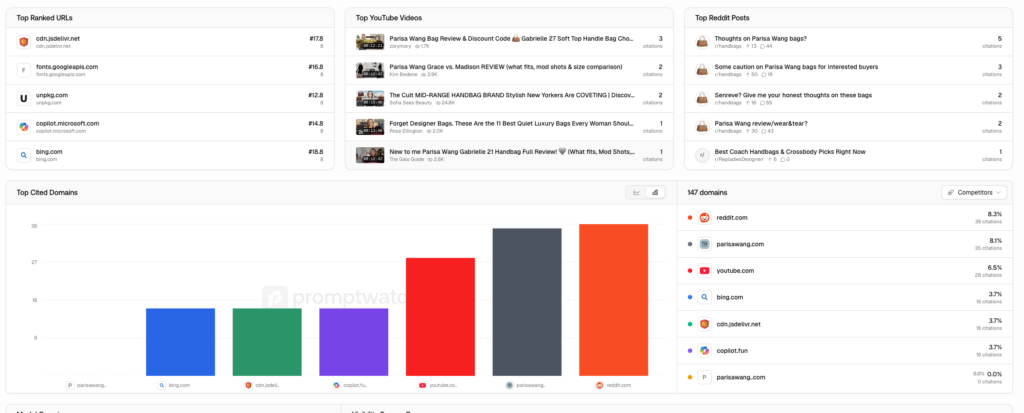
The dashboard gives a nice overview of competitors and sources. In our testing, the source visuals were one of the strongest parts of the product.
Promptwatch also includes offsite citation tracking, Reddit tracking, YouTube analysis, and citation analysis.
This is useful because AI engines often rely on third-party content, not only your own website. Reddit discussions, YouTube videos, reviews, and comparison pages can all influence how your brand appears in AI answers.
Content agents and content gap analysis
Promptwatch also includes content gap analysis, content briefs, citation tracking, and agents that can help create content for your website.
This can be helpful if your team wants to move from monitoring to content production.
Where Promptwatch falls short
Our main issue with Promptwatch is that some prompts can feel too directly connected to the brand.
For example, prompts like “Is [brand] worth it?” are useful, but they can also make visibility look higher than it really is. If many tracked prompts already include your brand name, the results may feel a bit inflated.
For AI visibility, non-branded prompts are often more important. These are the prompts where a potential customer is looking for a recommendation but does not already know which brand to choose.
Promptwatch is very good as a prompt monitoring tool, but it could do more when it comes to prioritizing the exact actions that will improve visibility.
Pricing
Promptwatch has a free Explore plan that includes one website, ChatGPT/OpenAI tracking, and 10 prompts. Its paid plans start at $99/month, with higher tiers for more prompts, more generated articles, location tracking, and additional analytics features.
Conclusion
Promptwatch is a good option if your main goal is prompt monitoring, source tracking, and understanding how your brand appears across AI engines.
It is easy to like, especially because the dashboards and source views are clear. Still, if your team needs stronger action recommendations and conversion tracking, you may outgrow it.
4. OtterlyAI
OtterlyAI is a solid AI visibility tool for brands that want to start monitoring how they appear across AI search engines.
It tracks brand mentions, citations, competitors, prompts, and visibility across platforms like ChatGPT, Perplexity, Google AI Overviews, Google AI Mode, Gemini, and Microsoft Copilot. It also includes brand reports, competitor views, citation tracking, crawlability checks, and GEO audits.
Otterly is easy to understand and offers a relatively accessible starting plan, which makes it appealing for teams that are just beginning to monitor AI search.
Key features
Brand visibility reports
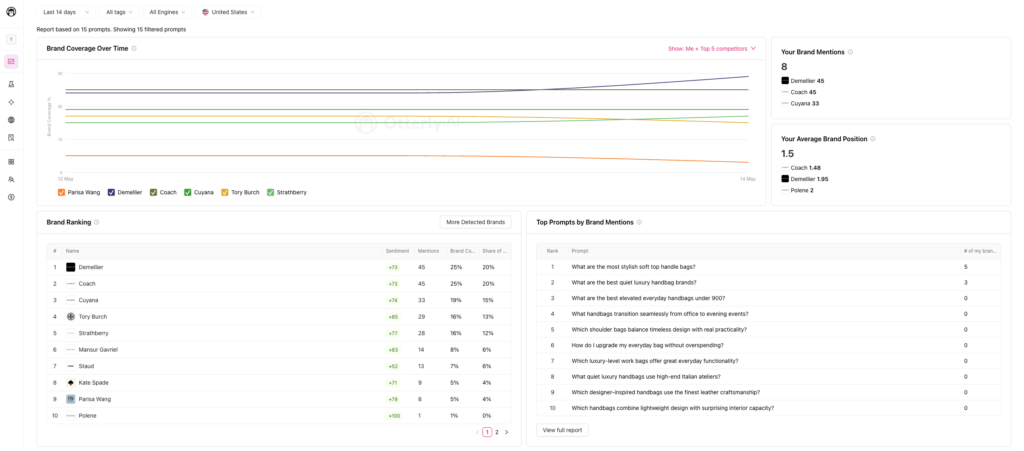
Otterly gives you brand reports that show how your brand appears across different AI engines, countries, and prompts.
One thing we liked is that Otterly shows a list of top brands in the results. This gives you a quick view of the market and helps you understand which brands are being recommended most often.
Prompt and competitor tracking
Otterly can help you monitor prompts and track how your brand performs across AI-generated answers. It also includes brand position tracking and competitor monitoring.
This is useful if you want a simple way to understand whether your brand is showing up for important searches and how often competitors appear next to you.
Citation tracking
Otterly tracks link citations, so you can see which pages and domains AI engines are using in answers.
This is helpful for identifying content opportunities. If competitors are being cited from comparison pages, review pages, or product pages, you can see which sources may be helping them appear more often.
Crawlability and content audits
Otterly also includes GEO crawlability and audit features. These can help check whether AI bots can access your website and whether your pages are structured in a way that AI engines can read.
We liked the crawlability checker. It is useful and easy to understand.
The content audit was more mixed. Some recommendations felt useful, especially around HTML and metadata structure. Others felt a bit generic or not as relevant as we would like.
Where Otterly falls short
Otterly is a nice tool, but it can feel a bit too focused on predefined or user-defined competitors.
That is not always bad, but we would also like to see more emphasis on competitors that AI engines naturally identify. Sometimes your real AI competitors are not the same as the ones you manually select.
The tool also provides recommendations, but they do not always feel as actionable or specific as they could be.
Pricing is another thing to keep in mind. The Lite plan is accessible, but it includes a limited number of prompts. If you need more serious monitoring, the cost moves up quickly.
Pricing
Otterly’s Lite plan starts at $29/month and includes 15 search prompts. The Standard plan is $189/month with 100 search prompts, while the Premium plan is $489/month with 400 search prompts. Annual billing lowers the monthly equivalent, and Otterly also offers a free trial for new users.
Conclusion
Otterly is a good option for teams that want a clear and approachable way to start tracking AI visibility.
It gives you useful monitoring, citation tracking, competitor views, and crawlability checks. However, the lower entry price should be viewed in context. Once you need more prompts or broader tracking, Otterly becomes a more serious investment.
For smaller teams, it can be a good starting point. For ecommerce brands that need deeper action recommendations, AI traffic attribution, and conversion tracking, a more complete tool may be a better fit.
5: Peec AI
Peec AI is a clean and focused AI search analytics platform.
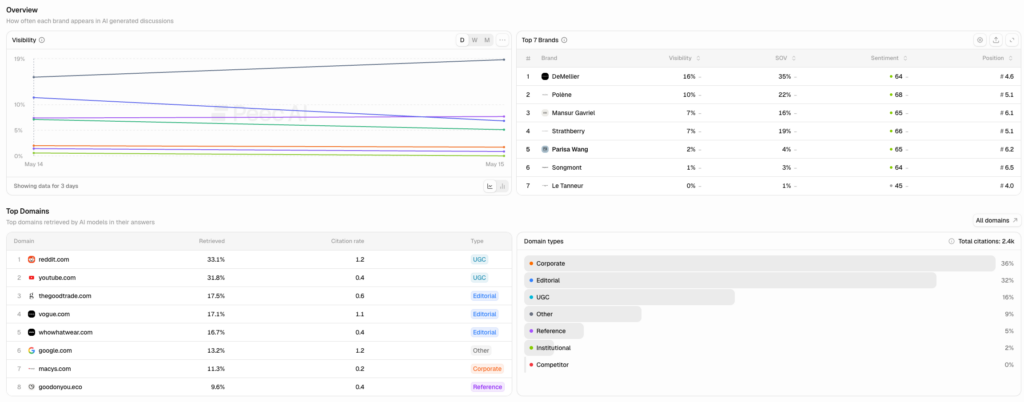
It helps marketing teams track, analyze, and improve how their brands perform across AI platforms. The interface is easy to understand, and the source analysis is one of the nicer parts of the product.
Peec AI is a good fit for teams that want a clear view of AI search visibility, prompt performance, cited sources, competitors, and sentiment.
Key features
Prompt tracking and organization
Peec lets users add prompts, organize them with tags, and track performance across countries and models. It also helps identify prompts that matter and provides AI-suggested prompts and search volume data.
In our testing, the query set felt relevant, which is important. A tool can have a lot of data, but if the prompts are not connected to how customers actually search, the insights become less useful.
Visibility, position, and sentiment
Peec tracks visibility, position, sentiment, and how your brand is perceived in AI-generated answers.
This gives you a clear overview of whether your brand is appearing, how it compares with competitors, and how AI engines describe it.
Source and URL analysis
One of Peec’s strengths is source analysis.
It tracks source visibility, citations, domains, and URLs. You can analyze results by category, domain, and exact URL, which makes it easier to understand which pages are influencing AI answers.
This is helpful if your team is trying to improve content coverage or understand why certain competitors are showing up more often.
Clean interface
Peec has a clean UI and is easy to navigate. The product feels focused and not overloaded, which is a plus.
For teams that want AI search analytics without a heavy SEO platform around it, Peec is a solid option.
Where Peec AI falls short
Peec AI is a strong tool for monitoring AI visibility, especially if you care about clean reporting, source analysis, and prompt-level tracking. Still, the pricing can climb quickly once you need more than the Starter setup.
The Starter plan includes 50 prompts, 3 models, and 1 project. That may be enough for a smaller brand or an initial AI visibility test, but teams that want to track more prompts, multiple projects, more markets, or broader model coverage will likely need to move to a higher plan. Peec also offers additional model tracking as an add-on, which can increase the total cost further.
Another thing to keep in mind is that Peec is very good at showing where you stand, but it still requires some interpretation. You get useful visibility, source, and competitor data, but the tool does not always translate that into the clearest step-by-step action plan for improving your rankings across AI engines.
Pricing
Peec AI pricing starts at $95/month for the Starter plan, which includes 50 prompts, 3 models, and 1 project. The Pro plan is $245/month and includes 150 prompts and 2 projects, while the Advanced plan is $495/month and includes 350 prompts, 5 projects, multi-country tracking, and integrations. There is also a custom Enterprise plan for larger teams. Overall, the pricing is clear, but it can get expensive quickly if you need more prompts, more projects, or broader model coverage.
Conclusion
Peec AI is a strong AI visibility monitoring tool with a clean interface and useful source analysis.
It is a good choice if you want to understand your AI visibility across prompts, models, sources, and competitors. However, it may not be the best fit if your main priority is actionable step-by-step guidance or ecommerce conversion tracking.
How to choose the right AI Visibility tool?
The right tool depends on what your team needs.
If you are just getting started, a simple and affordable monitoring tool may be enough. If you already have a large SEO workflow, you may want AI visibility inside your existing SEO platform. If you are an ecommerce brand, you probably need more than prompt tracking. You need to understand whether AI visibility leads to traffic, customers, and revenue.
Here are a few things to look at before choosing a tool.
1. Does it track the prompts that matter?
Prompt quality is one of the most important parts of AI visibility.
A tool should not only track branded prompts like “Is [brand] worth it?” It should also track non-branded, high-intent prompts where customers are still deciding what to buy.
These are often the prompts that matter most.
For example:
- “Best running shoes for flat feet”
- “Best supplement brand for sleep”
- “Best Shopify analytics app”
- “Best alternative to [competitor]”
- “Which [product category] is worth buying?”
If your brand appears in these answers, you are getting discovered earlier in the buying journey.
2. Does it show real competitors?
Your real AI competitors may not be the same as your internal competitor list.
AI engines may recommend brands you did not expect. They may also ignore competitors you thought were important.
A good AI visibility tool should help you discover which brands AI engines actually mention, compare, and recommend.
3. Does it analyze sources?
AI engines do not create answers from nothing. They rely on sources.
These can include:
- Your website
- Product pages
- Blog posts
- Review sites
- Comparison articles
- Reddit threads
- YouTube videos
- Press mentions
- Third-party directories
If you do not know which sources are shaping the answers, it is hard to know what to improve.
4. Does it give actionable recommendations?
This is one of the biggest differences between tools.
Some tools are great at showing data, but they leave the interpretation to you. Others help you understand what to do next.
The best AI visibility tool should help answer:
- Which prompts should we improve first?
- Which pages need better structure?
- Which missing content should we create?
- Which sources should mention us?
- Which competitors are beating us and why?
- What should we change on our website?
Data is useful, but action is what improves visibility.
5. Does it connect visibility with traffic and conversions?
This is especially important for ecommerce brands.
AI visibility is not only a branding metric. It can become a performance channel.
If AI engines recommend your brand and send users to your store, you need to know whether those users browse, add to cart, and buy.
That is why Lebesgue’s combination of AI visibility tracking and first-party traffic attribution is so valuable. It connects the discovery side with the revenue side.
Final thoughts
AI visibility is still early, but it is already becoming important.
Customers are using AI engines to discover brands, compare products, and get recommendations. That means brands need to understand how they appear in AI answers, which competitors are showing up, which sources are being cited, and what they can do to improve.
There are many good AI visibility tools on the market.
Semrush is a strong choice if you already use it for SEO and want a broad view of AI search. Promptwatch is a good prompt monitoring tool with useful source visuals. Otterly AI is a nice starting point for smaller teams. Peec AI offers clean analytics and strong source tracking.
But if you are an ecommerce brand and want to connect AI visibility with real business outcomes, Lebesgue is the best option.
It helps you track prompts, understand competitors, analyze sources, improve your website for AI engines, and measure actual AI-referred traffic and conversions.
AI search is not replacing SEO overnight, but it is becoming a new layer of discovery. The brands that start tracking it now will have a better chance of being recommended when customers ask AI engines what to buy next.
Frequently Asked Questions about AI Visibility Tools
AI visibility monitoring tools help you understand how your brand appears in AI-generated answers.
Instead of only tracking Google rankings, these tools track prompts, brand mentions, competitors, cited sources, sentiment, and visibility across AI engines like ChatGPT, Perplexity, Gemini, Claude, and Google AI Overviews.
In simple terms, they show whether AI engines understand your brand and whether they recommend it when users ask relevant questions.
You need an AI visibility monitoring tool because more users are discovering brands through AI engines.
People now ask AI tools for product recommendations, comparisons, alternatives, and buying advice. If your brand is not appearing in those answers, you may be missing an important discovery channel.
A good AI visibility tool helps you see where you stand, which competitors are being recommended instead, and what you can improve to increase your chances of being mentioned.
SEO tools focus mostly on traditional search rankings, keywords, backlinks, and organic traffic.
AI visibility tools focus on how your brand appears inside AI answers. That includes prompt tracking, AI-generated recommendations, cited sources, competitor mentions, and brand perception across AI platforms.
SEO is still important, but AI visibility adds another layer. Brands now need to think not only about ranking on Google, but also about being recommended by AI engines.
A good AI visibility tool should help you track important prompts, monitor competitors, analyze cited sources, and understand how AI engines describe your brand.
The best tools go one step further and give you actionable recommendations. It is not enough to know that your brand is missing from an answer. You also need to know what to improve.
For ecommerce brands, it is also valuable to connect AI visibility with real traffic and conversions, so you can see whether AI mentions are actually bringing customers to your store.
Some tools can show visibility and mentions, but not all of them connect that data to traffic and conversions.
This is where Lebesgue is especially useful. Because Lebesgue combines AI Visibility tracking with Le Pixel first-party tracking, you can see which AI engines are sending traffic and whether those visitors convert.
That gives you a much clearer view of AI as a real performance channel, not just a brand awareness metric.
Improving AI visibility usually starts with understanding where your brand is missing and why.
That can include improving your website structure, creating clearer product and category pages, publishing helpful comparison content, earning mentions from trusted sources, and making sure AI bots can crawl your site properly.
Tools like Lebesgue help by identifying visibility gaps, analyzing cited sources, and showing the highest-impact areas to improve first.